Tuesday, June 1, 2010

USS Cleveland (Cruiser No. 19/PG-33/CL-21)


Figure 1: USS Cleveland (Cruiser No. 19) underway in 1904. US Naval Historical Center Photograph. Click on photograph for larger image.


Figure 2: USS Cleveland (Cruiser No. 19) photographed circa 1907, probably just before beginning her cruise to the Far East by way of the Suez Canal. Copied from the Album of Assistant Paymaster Francis J. Daly, by courtesy of Commander Thomas M. Daly, USN, 1984. US Naval Historical Center Photograph. US Naval Historical Center Photograph. Click on photograph for larger image.


Figure 3: USS Cleveland (Cruiser No. 19) in the "Dewey" Dry Dock, Olongapo Naval Station, Philippine Islands, circa 14 January 1908. Copied from the Album of Assistant Paymaster Francis J. Daly, by courtesy of Commander Thomas M. Daly, USN, 1984. US Naval Historical Center Photograph. Click on photograph for larger image.


Figure 4: USS Cleveland (Cruiser No. 19) in the "Dewey" Dry Dock, Olongapo Naval Station, Philippine Islands, circa 14 January 1908. Note her decorated stern and the officer posed on the starboard propeller. Copied from the Album of Assistant Paymaster Francis J. Daly, by courtesy of Commander Thomas M. Daly, USN, 1984. US Naval Historical Center Photograph. Click on photograph for larger image.
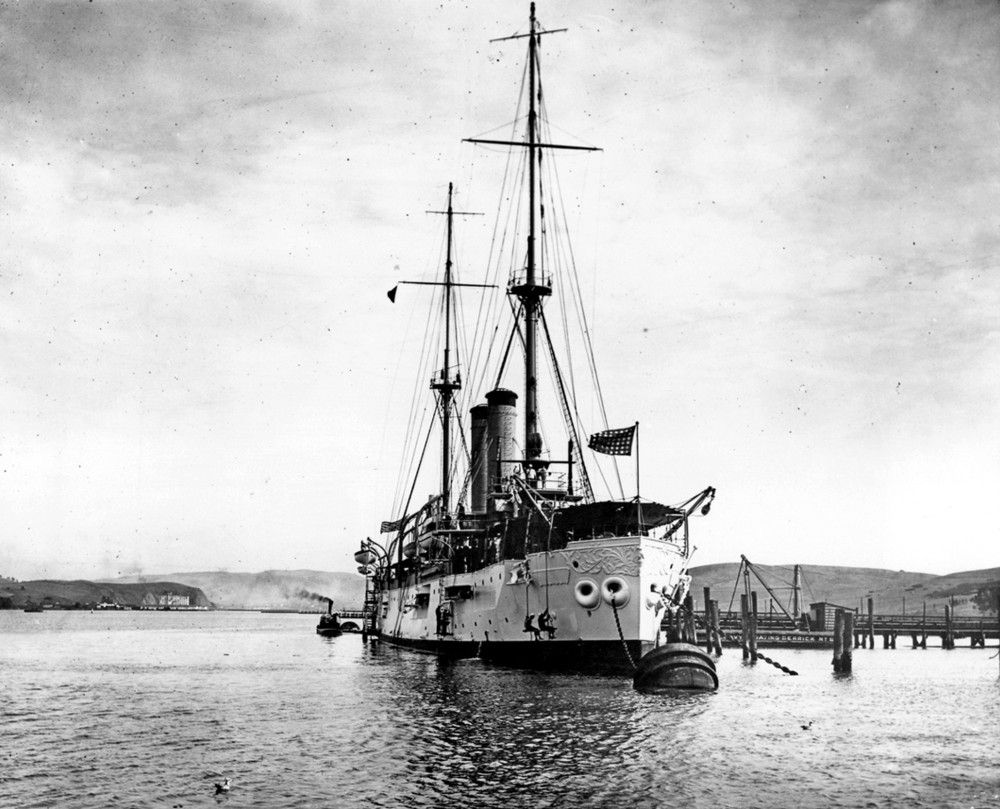

Figure 5: USS Cleveland (Cruiser No. 19) moored at Mare Island Navy Yard, California, in 1914 acting as the shipyard's receiving ship. US Navy photograph. Click on photograph for larger image.


Figure 6: Starboard side view of USS Cleveland (Cruiser No. 19) in the Mare Island Navy Yard channel on 25 April 1914. US Navy photograph. Click on photograph for larger image.


Figure 7: Port side view of USS Cleveland (Cruiser No. 19) in the Mare Island Navy Yard channel on 25 April 1914. US Navy photograph. Click on photograph for larger image.


Figure 8: USS Cleveland (Cruiser No. 19) off the Mare Island Navy Yard, California, 30 October 1915. Courtesy of Donald M. McPherson, 1970. US Naval Historical Center Photograph. Click on photograph for larger image.


Figure 9: Port side view of USS Cleveland (Cruiser No. 19) at Mare Island on 7 September 1916. The tug USS Active (YT-14) is behind Cleveland. US Navy Photograph. Click on photograph for larger image.


Figure 10: Starboard side view of USS Cleveland (Cruiser No. 19) at Mare Island on 7 September 1916. The tug USS Active (YT-14) is along side. US Navy Photograph. Click on photograph for larger image.


Figure 11: USS Cleveland (Cruiser No. 19) escorting a World War I convoy, 1918. The original image is printed on post card ("AZO") stock. Donation of Dr. Mark Kulikowski, 2007. US Naval Historical Center Photograph. Click on photograph for larger image.


Figure 12: USS Cleveland (CL-21), closest to the camera, and USS Galveston (CL-19) seen from USS Hannibal (AG-1), circa 1923, probably in Cuban waters. Courtesy of the Naval Historical Foundation. Collection of LeRoy R. Horstman. US Naval Historical Center Photograph. Click on photograph for larger image.


Figure 13: Painting of USS Cleveland (CL-21) by an unidentified artist. Courtesy of Mr. Fred Bristol, 1971. US Naval Historical Center Photograph. Click on photograph for larger image.


Figure 14: "In Remembrance of My Cruise in China, Japan and P.I." Silk embroidered tapestry featuring a photograph of Henry Rockwell Mousseau, his medals and an embroidered portrait of his ship, USS Cleveland (Cruiser No. 19). Cleveland served in the Far East during 1907-1910. Courtesy of Richard Mosseau, 1981. US Naval Historical Center Photograph. Click on photograph for larger image.


Named after a city in Ohio, the 3,200-ton USS Cleveland (Cruiser No. 19) was the last of six Denver class “protected cruisers,” which were ships that possessed armor protection on their main decks but not on their sides. Also known as “Peace Cruisers,” these slow, lightly-armed and armored ships were never meant for fleet actions. They were used as gunboats with the Asiatic Fleet and in the waters off Central America and South America, as well as in the Caribbean and the Mediterranean. Because they were needed to patrol distant waters with little support, the Denver class ships were furnished with sails to extend their cruising range while economizing on coal, but they also had large coal bunkers, which increased their range and endurance. Their steel hulls were sheathed with pine and coppered for long service in tropical waters and they possessed roomy, well-ventilated quarters for their crews to ease the discomfort of sailing in hot climates. Each Denver class warship had a two-and-one-half-inch-thick armored deck and was armed with ten 5-inch rapid-fire guns. USS Cleveland was built by the Bath Iron Works at Bath, Maine, and was commissioned 2 November 1903. She was approximately 308 feet long and 44 feet wide, had a top speed of 16 knots, and had a crew of 339 officers and men.

Cleveland was assigned first to the European Squadron and patrolled the waters off the West Indies, Cuba, and along the east coast of the United States. Cleveland remained with the European Squadron until 17 May 1907, when she left New York and headed to the Far East via Gibraltar, Port Said, Aden, Colombo, Singapore, and then finally arrived at Cavite in the Philippines on 1 August. Cleveland was part of the Asiatic Fleet for the next three years, protecting American lives and property in the area. Cleveland returned to the United States via the Pacific Ocean and arrived at the Mare Island Navy Yard, California, on 1 August 1910. She was decommissioned on 3 August and placed in reserve.

Cleveland was re-commissioned on 31 August 1912. The cruiser spent the next five years patrolling the waters off the coast of Mexico and Central America. As was usual for gunboats, Cleveland’s primary duty was to protect American lives and property in the politically volatile nations of Latin America. But with the United States drawing closer and closer to war with Germany, Cleveland was assigned to the east coast of the United States and on 31 March 1917 arrived at Hampton Roads, Virginia. From 9 April to 22 June, she patrolled from Cape Hatteras, North Carolina, to Charleston, South Carolina, searching for German submarines and surface raiders. From June 1917 to November 1918, Cleveland escorted seven convoys that were headed from the United States to Europe. She escorted the convoys to a midway point between the United States and Europe in the Atlantic Ocean. Cleveland then was relieved by Allied escorts from Britain or France that brought the convoy the rest of the way to Europe.

After the war ended in November 1918, Cleveland returned to patrolling off the coasts of Central and South America. But Cleveland once again was assigned to the Asiatic Fleet in February 1920. She also officially was re-classified as a gunboat (PG-33) in July 1920, but again was re-classified in August 1921, this time as a light cruiser (CL-21). Cleveland remained active in the Caribbean and South American waters during the 1920s, making courtesy calls to various ports, supporting diplomatic missions, providing disaster relief when necessary, and protecting American interests in the area when needed. USS Cleveland was decommissioned in Boston on 1 November 1929 and was sold for scrapping on 7 March 1930.

Tuesday, May 25, 2010

USS Corsair (SP-159)


Figure 1: Corsair (American Steam Yacht, 1899) photographed prior to her World War I naval service. This yacht was chartered from her owner, financier J.P. Morgan, and placed in commission on 15 May 1917 as USS Corsair (SP-159). Returned to Mr. Morgan on 9 June 1919, she again served in the Navy during World War II as USS Oceanographer (AGS-3). Courtesy of J.P. Morgan, 1930. US Naval Historical Center Photograph. Click on photograph for larger image.


Figure 2: Corsair (American Steam Yacht, 1899) photographed by Edwin Levick of New York City, prior to her World War I Naval service. Built in 1899 for financier J.P. Morgan, this yacht served as USS Corsair (SP-159) during World War I and as USS Oceanographer (AGS-3) during World War II. The original print is in National Archives' Record Group 19-LCM. US Naval Historical Center Photograph. Click on photograph for larger image.


Figure 3: USS Corsair (SP-159) fine screen halftone reproduction of a photograph taken while she was fitting out for World War I service, circa May 1917. Next ship outboard is USS Harvard (SP-209). Courtesy of Alfred Cellier, 1977. US Naval Historical Center Photograph. Click on photograph for larger image.


Figure 4: USS Californian sinking in the Bay of Biscay after striking a mine, 22 June 1918. Photographed from USS Corsair (SP-159). Collection of Paul F. Wangerin, 1975. US Naval Historical Center Photograph. Click on photograph for larger image.


Figure 5: USS Californian sinking in the Bay of Biscay on 22 June 1918, after hitting a mine. Photographed from USS Corsair (SP-159). Collection of Paul F. Wangerin, 1975. US Naval Historical Center Photograph. Click on photograph for larger image.


Figure 6: One of the ship's lifeboats from USS Californian comes alongside USS Corsair (SP-159), as Californian was being abandoned in the Bay of Biscay on 22 June 1918. She sank after hitting a mine. The original print bears the hand-written note: "S.S. Californian last boat." Collection of Paul F. Wangerin, 1975. US Naval Historical Center Photograph. Click on photograph for larger image.


Figure 7: Survivors of USS Californian on USS Corsair's quarterdeck, 22 June 1918, after being rescued from their sinking ship. Note the cork life vests worn by many of these men. Collection of Paul F. Wangerin, 1975. US Naval Historical Center Photograph. Click on photograph for larger image.


Figure 8: S.S. Dagfin (Norwegian Freighter, 1902) broken down several hundred miles off the French coast on 12 September 1918. Photographed from USS Corsair (SP-159), which towed her to port. She is flying distress signal flags: "N-I". Collection of Paul F. Wangerin, 1975. US Naval Historical Center Photograph. Click on photograph for larger image.


Figure 9: S.S. Dagfin (Norwegian Freighter, 1902) broken down several hundred miles off the French coast on 12 September 1918. Photographed from USS Corsair (SP-159), which towed her to port. The original print bears the hand-written note: "Norwegian tramp picked up by Paul (Wangerin, one of Corsair's officers) about 600 miles West of France, disabled 6 days, during War." Collection of Paul F. Wangerin, 1975. US Naval Historical Center Photograph. Click on photograph for larger image.


Figure 10: USS Corsair (SP-159) depth charge exploding astern of the ship, during operations at sea in 1918. Another depth charge is visible in the foreground. Collection of Paul F. Wangerin, 1975. US Naval Historical Center Photograph. Click on photograph for larger image.


Figure 11: Secretary of the Navy Josephus Daniels (standing to left of the ship's after conning station) talking with a group of officers while USS Corsair was at Plymouth, England, in May 1919. Standing at right are the ship's Commanding Officer, Lieutenant Commander William B. Porter, USNRF, and Rear Admiral Ralph Earle, USN. Note depth charge stowage racks in the foreground. Courtesy of Lieutenant C.C. Moore, USN, 1930. US Naval Historical Center Photograph. Click on photograph for larger image.


Figure 12: USS Corsair’s officers and crew posed on her after deck in mid-1917, soon after she entered Navy service. Officers are (left to right): unidentified; Lieutenant Commander William B. Porter, USNRF; Lieutenant Commander Theodore A. Kittinger, USN; Lieutenant Robert E. Tod, USNRF; Lieutenant (Junior Grade) John K. Hutchinson, USNRF; Lieutenant (Junior Grade) Roy J. McGuire, USNRF (? -- uniform is that of a warrant officer); and unidentified warrant officer. US Naval Historical Center Photograph. Click on photograph for larger image.


Figure 13: Members of USS Corsair’s crew posed on the after deckhouse in mid-1917, soon after she entered Navy service. These men are spelling out Corsair's name in semaphore ("wig-wag") code. Note the ship's after conning station in the center foreground, speaking tubes at the end of the deckhouse, and the after pair of 3-inch guns. US Naval Historical Center Photograph. Click on photograph for larger image.


Figure 14: Chief Petty Officer and another crew member on USS Corsair’s bridge, while at Brest, France, in 1918. Another US Navy converted yacht is in the background with a kite balloon overhead. Collection of Paul F. Wangerin, 1975. US Naval Historical Center Photograph. Click on photograph for larger image.


Figure 15: Corsair (American Steam Yacht, 1899) photographed circa the 1920s. Built in 1899 for financier J.P. Morgan, this yacht served as USS Corsair (SP-159) during World War I and as USS Oceanographer (AGS-3) during World War II. Courtesy of Donald M. McPherson, 1975. US Naval Historical Center Photograph. Click on photograph for larger image.


Figure 16: US Coast and Geodetic Survey Oceanographer (OSS-26) underway, circa 1934, place unknown. Courtesy Jim Rogers. Click on photograph for larger image.


Figure 17: USS Oceanographer (AGS-3) moored to a pier, circa 1943, place unknown. US Navy photograph. Click on photograph for larger image.


Figure 18: USS Oceanographer (AGS-3) moored to a pier at San Pedro, California, 1944. US Navy photograph. Click on photograph for larger image.


Figure 19: USS Oceanographer (AGS-3) moored to a pier at San Pedro, California, 1944. US Navy photograph. Click on photograph for larger image.


The 1,600-ton steam yacht Corsair was built in 1899 for the famous financier J.P. Morgan by W. & A. Fletcher Company, at Hoboken, New Jersey. Since a “corsair” was a pirate or privateer, the name seemed extremely suitable for a man like J.P. Morgan. After the United States entered World War I in April 1917, the US Navy quickly needed escort ships for convoy duty. Believing Corsair could be converted into a suitable patrol boat or ocean escort, the Navy chartered Morgan’s yacht in early May 1917 and commissioned the ship as USS Corsair (SP-159) on 15 May. The ship quickly was converted into a patrol boat and given four 3-inch guns and depth charges. Corsair was approximately 304 feet long and 33 feet wide, had a top speed of 19 knots, and had a crew of 146 officers and men.

Corsair left New York for France on 14 June 1917 as part of the escort group for the first contingent of American Expeditionary Force troops to be sent to Europe. The convoy arrived at St. Nazaire, France, on 27 June. Corsair quickly was assigned to anti-submarine and escort duties off the west coast of France. She escorted numerous vessels and rescued people from torpedoed or disabled merchant ships. On 17 October 1917, Corsair rescued a large number of survivors from the torpedoed US Army transport Antilles and then searched the area for the German submarine that attacked her. On 22 June 1918, Corsair rescued survivors from the American merchant ship Californian, which had struck an enemy mine. Both Antilles and Californian sank after Corsair rescued their survivors. But on 12 September 1918, Corsair assisted the disabled Norwegian steamer Dagfin and towed her to safety to a French port.

After the war ended on 11 November 1918, Corsair steamed to England and occasionally was used as the flagship for the Commander, US Naval Forces in European Waters. In May 1919, Corsair carried Secretary of the Navy Josephus Daniels and his staff from England to France and the ship returned to the United States later that month. After her arrival, USS Corsair was decommissioned and on 9 June 1919 the ship was returned to her original owner, J.P. Morgan.

After several more years of use as a private yacht, Corsair was purchased by the US Coast and Geodetic Survey and renamed Oceanographer. The ship was used as a scientific research vessel during the 1930s and into the early 1940s. But a few months after America entered World War II on 7 December 1941, the US Navy came calling once again. The Navy re-acquired the former yacht in April 1942, re-named her Natchez, and briefly re-classified her as a gunboat (PG-85). But something caused the Navy to change its mind about the elderly ship because her name and classification were changed once again. In August 1942, she was re-classified as a survey ship, was re-commissioned back into the Navy, but assumed an old name, USS Oceanographer (AGS-3).

Initially sent to Alaskan waters to perform surveys, Oceanographer seemed unable to cope with the harsh weather conditions in that part of the world. Therefore, she was sent to the south Pacific in March 1943. The ship remained there conducting extensive surveys until June 1944, when she returned to the United States for urgently needed repairs. But soon after arriving at San Pedro, California, the US Navy determined that the battered and now extremely elderly ex-yacht was not worth repairing. USS Oceanographer was decommissioned in September 1944 and was scrapped soon after that. Although she started her life as the expensive plaything for one of the world’s richest men, this tough ship proved to be a useful warship in one war and an excellent survey vessel in another. Few ships have had a career like that.

Tuesday, May 18, 2010

SMS Geier/USS Schurz


Figure 1: The German cruiser SMS Geier of the Imperial German Navy, circa 1894 to 1914. Courtesy Deutsches Bundesarchiv (German Federal Archive). Click on photograph for larger image.


Figure 2: Kaiser Wilhelm II visiting the German cruiser SMS Geier and addressing the crew, date unknown, probably at the Imperial Dockyard at Wilhelmshaven, Germany. Courtesy Deutsches Bundesarchiv (German Federal Archive). Click on photograph for larger image.


Figure 3: Kaiser Wilhelm II inspecting the officers of the German cruiser SMS Geier, date unknown, probably at the Imperial Dockyard at Wilhelmshaven, Germany. Courtesy Deutsches Bundesarchiv (German Federal Archive). Click on photograph for larger image.


Figure 4: Kaiser Wilhelm II inspecting the crew of the German cruiser SMS Geier, date unknown, probably at the Imperial Dockyard at Wilhelmshaven, Germany. Courtesy Deutsches Bundesarchiv (German Federal Archive). Click on photograph for larger image.


Figure 5: Kaiser Wilhelm II on the bridge of the German cruiser SMS Geier, date unknown, probably at the Imperial Dockyard at Wilhelmshaven, Germany. Courtesy Deutsches Bundesarchiv (German Federal Archive). Click on photograph for larger image.


Figure 6: SMS Geier in the Kaiser Wilhelm Canal, date unknown. Courtesy: http://www.kaiserliche-marine.de/. Click on photograph for larger image.


Figure 7: Post card showing SMS Geier in 1894, probably shortly after being launched. Courtesy theFrankes.com, also at: http://www.thefrankes.com/wp/?p=593. Click on photograph for larger image.


Figure 8: SMS Geier, date and place unknown. Courtesy U.S. Warships of World War I. Click on photograph for larger image.


Figure 9: USS Schurz, formerly SMS Geier, date and place unknown. Courtesy Robert Hurst . Click on photograph for larger image.


SMS (which stands for Seiner Majestät Schiff or His Majesty's Ship) Geier was a 1,630-ton Bussard class cruiser that was built by the Kaiserliche Werft (Imperial Dockyard) at Wilhelmshaven, Germany, and was launched on 18 October 1894. Geier, which means vulture in German, had a steel hull and coal-fired engines, and was equipped with a barque sail rig to extend her range (this was later changed to a schooner rig). The ship was commissioned into the German Imperial Navy (Kaiserliche Marine) on 24 October 1895. Geier was approximately 254 feet long and 32 feet wide, had a top speed of 16 knots, and had a crew of 197 officers and men. Geier originally was armed by the German Navy with eight 4.1-inch guns, five 37-mm guns, and two 17-inch torpedo tubes, but was converted to carry only four 5-inch guns when the ship was commissioned into the US Navy.

Although originally built to serve in Germany’s overseas colonies, Geier remained in local German waters for roughly four years. Her extensive colonial duties began in 1898, when she steamed to Haiti to assist in suppressing an uprising there. Later that same year, she participated in the evacuation of German citizens from Havana, Cuba, during the Spanish-American War. For the next two years, Geier patrolled off the coast of South America, visiting German and foreign naval bases. In 1899, Geier was re-classified from a cruiser to a light cruiser. In 1900, Geier was sent to China to protect German troops and interests during the infamous Boxer Rebellion. The ship remained in China until 1905 and then returned to European waters. From 1911 to 1913, Geier took part in the Italo-Turkish war, protecting German citizens and property during that violent conflict. In 1913, the ship was ordered to sail to Dar es Salaam, located in what then was known as German East Africa. While in East African waters, Geier resumed her usual duties of guarding German citizens and financial interests in the area. She also was re-classified once again in May 1914 and was downgraded from a light cruiser to a gunboat.

Shortly after the start of World War I in August 1914, Geier was ordered to steam from German East Africa to Germany’s colonial base at Tsingtao, China. Once there, she was to join Admiral Maximilian Graf von Spee’s Far Eastern Squadron. However, patrolling British, French, and Japanese warships in the area prevented the small gunboat from reaching her destination. Geier, therefore, began independent commerce raiding operations while eluding Allied warships. In early September, Geier captured the British freighter Southport in the Eastern Caroline Islands. Geier’s crew attempted to disable the merchant ship’s engines and then sailed on. But the crew of the Southport was able to fix the damaged engines and sail to Australia, where her captain reported the incident to British Naval authorities. Geier then was a hunted ship, but managed to avoid being captured for roughly a month. By this time Geier also had covered a lot of ocean and was in urgent need of repairs and coal. Her captain, therefore, decided to enter a neutral port to buy some time for his ship. On 17 October 1914, Geier entered the neutral US port at Honolulu, Hawaii. Soon after her arrival, though, two Japanese warships (the battleship Hizen and the armored cruiser Asama) arrived in the area and began patrolling outside of Hawaii’s three-mile limit, waiting for Geier to leave the neutral port. But on 8 November, Geier was interned by the United States.

Once the United States entered World War I on 6 April 1917, Geier was seized by the US Navy and on 9 June were renamed Schurz, after Carl Schurz, the famous American writer, speaker, Union Army general, and politician. The ship was overhauled and officially commissioned into the US Navy as USS Schurz on 15 September 1917. On 31 October, Schurz left Pearl Harbor, Hawaii, and escorted Submarine Division 8 to San Diego, California. After arriving on 12 November, Schurz continued her journey in early December by escorting four submarines south to the Panama Canal. After transiting the canal at the end of December, the small convoy proceeded north to Honduras. On 4 January 1918, Schurz was relieved of escort duty and steamed to Key West, Florida. After making a brief visit to New Orleans, Louisiana, Schurz left on 1 February for Charleston, South Carolina, to be dry docked and overhauled.

Schurz left Charleston by the end of April 1918 and was assigned to the American Patrol Detachment. For the next two months, Schurz patrolled the waters off America’s east coast and the Caribbean and was given escort and towing missions. On 19 June, she left New York for Key West. But during the early morning hours of 21 June 1918, Schurz was rammed off Cape Lookout, North Carolina, by the merchant ship Florida. Florida hit the gunboat on the starboard side, smashing part of the bridge and causing major damage below the waterline. One of Schurz’s crewmembers was killed during the collision and twelve others were injured. Seeing that the gunboat could not be saved, USS Schurz’s captain, Commander Arthur Crenshaw, gave the order to “abandon ship” and three hours later she sank.

Tuesday, May 11, 2010

USS Wyoming (Monitor No. 10, later USS Cheyenne)


Figure 1: USS Wyoming (Monitor No. 10) making 12.4 knots during trials off San Francisco, California, in October 1902. Courtesy of the San Francisco Maritime Museum, 1971. The original print is in the Union Iron Works scrapbook, Volume II, page 166. US Naval Historical Center Photograph. Click on photograph for larger image.


Figure 2: USS Wyoming (Monitor No. 10) making 12.4 knots during trials near San Francisco, California, in October 1902. Courtesy of the San Francisco Maritime Museum, 1971. The original print is in the Union Iron Works scrapbook, Volume II, page 166. US Naval Historical Center Photograph. Click on photograph for larger image.


Figure 3: View on board USS Wyoming (Monitor No. 10), looking forward, showing water coming over her bow while she was running trials off San Francisco, California, in October 1902. Note the ship's 12-inch gun turret at right. Courtesy of the San Francisco Maritime Museum, 1971. The original print is in the Union Iron Works scrapbook, Volume II, page 166. US Naval Historical Center Photograph. Click on photograph for larger image.


Figure 4: View on board USS Wyoming (Monitor No. 10), looking forward, while she was running trials off San Francisco, California, in October 1902. Note water pouring over her bow bulwark and men sitting on the 12-inch gun at right. Courtesy of the San Francisco Maritime Museum, 1971. The original print is in the Union Iron Works scrapbook, Volume II, page 167. US Naval Historical Center Photograph. Click on photograph for larger image.


Figure 5: USS Wyoming (Monitor No. 10) moored off the Mare Island Navy Yard, California, on 12 February 1903. US Naval Historical Center Photograph. Click on photograph for larger image.


Figure 6: USS Wyoming (Monitor No. 10) moored off the Mare Island Navy Yard, California, on 12 February 1903. US Naval Historical Center Photograph. Click on photograph for larger image.


Figure 7: USS Wyoming (Monitor No. 10) off the Mare Island Navy Yard, California, circa 1902-1908. The original photograph is printed on a silver-finish paper. Donation of Rear Admiral Ammen Farenholt, USN (Medical Corps). US Naval Historical Center Photograph. Click on photograph for larger image.


Figure 8: USS Wyoming (Monitor No. 10) in a west coast harbor, circa 1902-1908. Donation of Rear Admiral Ammen Farrenholt, USN (Medical Corps), 1936. US Naval Historical Center Photograph. Click on photograph for larger image.


Figure 9: USS Wyoming (Monitor No. 10) post card published by Edward H. Mitchell, San Francisco, California, featuring a color-tinted photograph of Wyoming taken circa 1902-1908. Donated by USS Parsons (DD-949), 1967. The Naval Historical Center's Photograph Collection contains another copy of this postcard that is postmarked Tacoma, Washington, 1 June 1908. US Naval Historical Center Photograph. Click on photograph for larger image.


Figure 10: USS Wyoming (Monitor No. 10) in 1904, place unknown. US Naval Historical Center Photograph. Click on photograph for larger image.


Figure 11: USS Wyoming (Monitor No. 10), now re-named USS Cheyenne, moored off Bremerton, Washington, while serving as a training ship for the Washington State Naval Militia, circa 1910-1913.The original is a screened sepia-toned image, printed on a contemporary post card. US Naval Historical Center Photograph. Click on photograph for larger image.


Figure 12: USS Cheyenne (Monitor No. 10) at anchor in a west coast harbor, circa 1916. Collection of Thomas P. Naughton, 1973. US Naval Historical Center Photograph. Click on photograph for larger image.


Figure 13: USS Cheyenne (Monitor No. 10) with a submarine alongside, circa 1918-1919. The submarine is probably one of the Division 3 boats tended by Cheyenne: K-3, K-4, K-7, or K-8. Location may be Key West, Florida. US Naval Historical Center Photograph. Click on photograph for larger image.


Figure 14: USS Cheyenne (Monitor No. 10), at right, with a submarine in the foreground, circa 1918-1919. The submarine is probably one of the Division 3 boats tended by Cheyenne: K-3, K-4, K-7 or K-8. Location may be Key West, Florida. US Naval Historical Center Photograph. Click on photograph for larger image.


Figure 15: USS Cheyenne (IX-4), inboard at left; USS S-12 (SS-117), outboard at left; and USS Dale (DD-290) at the Philadelphia Navy Yard, Pennsylvania, on 14 June 1926. US Naval Historical Center Photograph. Click on photograph for larger image.


USS Wyoming (Monitor No. 10) was a 3,225-ton Arkansas class monitor built by the Union Iron Works at San Francisco, California, and was commissioned on 8 December 1902. She was approximately 255 feet long and 50 feet wide, had a top speed of 12.5 knots, and had a crew of 220 officers and men. Wyoming was armed with two 12-inch guns, four 4-inch guns, and two 6-pounders.

After fitting out at the Mare Island Navy Yard at Vallejo, California, Wyoming completed her shakedown cruise off California and spent the bulk of her time steaming along America’s west coast. Since monitors were terrible sea boats and always ran the danger of foundering in heavy seas, Wyoming generally remained in coastal waters. A few monitors did attempt, and successfully completed, long open-ocean voyages, but these were the exceptions and not the norm. These ships generally hugged the coastline and were meant purely for coastal defense work.

In the fall of 1903, civil war threatened to divide Columbia, placing American lives and property in danger. Wyoming was ordered to steam south as part of the US Navy’s reaction to the political unrest that was tearing Columbia apart. Wyoming reached Columbian waters on 13 November 1903 and her presence, along with other ships from the US Navy, allowed Panama to declare its independence from Columbia. Wyoming remained in what were now Panamanian waters until the spring of 1904, to ensure the security of the new government in Panama. This was probably one of the most famous examples of American “gunboat diplomacy,” because independence for Panama eventually allowed the United States to build the Panama Canal. After the political situation had stabilized sufficiently within Panama, Wyoming left on 19 April 1904. Wyoming returned north and, after making a few stops in Mexico, arrived at San Diego, California, on 14 May.

Wyoming spent the rest of 1904 and part of 1905 patrolling off America’s west coast while also making occasional visits to Mexico and Central America. She was decommissioned at the Mare Island Navy Yard on 29 August 1905. Wyoming was re-commissioned on 8 October 1908 and was the first ship in the US Navy to be converted from coal-fired engines to oil. While acting as a test ship for this new technology, Wyoming was renamed Cheyenne on 1 January 1909 to free her name up for a new battleship. After undergoing more testing, Cheyenne was decommissioned once again on 13 November 1909.

Cheyenne was re-commissioned but placed in reserve on 11 July 1910. The monitor was loaned to the Washington State naval militia in 1911 and served as a training ship until February 1913, when she was converted into a submarine tender. In 1914, Cheyenne assisted in the evacuation of refugees from Mexico, which at that time was engulfed in a violent civil war. Cheyenne continued working as a submarine tender for the next few years and during World War I served in the Atlantic, tending to submarines in the Gulf of Mexico.

After the war ended, Cheyenne was transferred to Division 1 of the American Patrol Detachment. While serving with that unit, Cheyenne was sent to Tampico, Mexico, to protect American lives and property from 15 January to 9 October 1919. After that, she headed north along America’s east coast and was decommissioned at the Philadelphia Navy Yard, Pennsylvania, on 3 January 1920. While inactive at Philadelphia, Cheyenne was reclassified IX-4 as a miscellaneous auxiliary on 17 July 1920.

Cheyenne was re-commissioned at Philadelphia on 22 September 1920 and the ship was towed to Baltimore, Maryland. Once there, Cheyenne was used as a training ship for US Navy reservists until 1925. On 21 January 1926, Cheyenne was towed to Philadelphia and was decommissioned for the last time on 1 June. The old monitor languished there for more than ten years before being struck from the Navy list on 25 January 1937. USS Cheyenne was the last of the Navy’s big-gun monitors and her stripped-down hulk was sold for scrap on 20 April 1939.