Tuesday, August 24, 2010

USS Isla de Cuba

PLEASE NOTE: Due to a conflict in my schedule, the ship that was to be posted on Tuesday, August 31, will be posted on Thursday, September 2.


Figure 1: Isla de Cuba (Spanish Cruiser, 1886-1898) photographed soon after completion, probably in a British port. This small cruiser was lost at Manila Bay, 1 May 1898, but was salvaged and entered the US Navy under her Spanish name. She was sold in 1912 and became the Mariscal Sucre in the Venezuelan Navy. Copied from Office of Naval Intelligence Album of Foreign Warships. US Naval Historical Center Photograph. Click on photograph for larger image.


Figure 2: Scuttled wreck of the Spanish cruiser Isla de Cuba, photographed sometime after the Battle of Manila Bay, 1 May 1898. This ship was later salvaged and became USS Isla de Cuba. Donation of Lt. C.J. Dutreaux, USNR(Ret), 1947. US Naval Historical Center Photograph. Click on photograph for larger image.


Figure 3: USS Isla de Cuba, American gunboat from 1900 to 1912. US Naval Historical Center Photograph. Click on photograph for larger image.


Figure 4: Postcard from 1908 depicting the gunboat USS Isla de Cuba at the Portsmouth, New Hampshire, Navy Yard. Photograph courtesy of Arnold A. Putnam. Click on photograph for larger image.


Figure 5: The Mariscal Sucre of the Venezuelan Navy, circa 1918. She was formerly the American gunboat USS Isla de Cuba. Photograph from the 1924 edition of Jane's Fighting Ships. Click on photograph for larger image.


The Isla de Cuba was a 1,030-ton Isla de Luzon class cruiser built in 1886 for the Spanish Navy by the British shipbuilder W.G. Armstrong at Newcastle-on-Tyne, England. The ship was approximately 197 feet long and 30 feet wide, had a top speed of 13 knots, and had a crew of 137 officers and men. As built, Isla de Cuba was armed with four 4-inch guns, four 6-pounders, and three torpedo tubes. This armament, though, was altered slightly in later years.

At the time of the Spanish-American War, Isla de Cuba was part of the Spanish Squadron based in the Philippines. She was scuttled and sunk by the Spanish during the Battle of Manila Bay on 1 May 1898. After the war was over, the US Navy salvaged the ship and, after extensive repairs were made at Hong Kong, commissioned the vessel into the Navy on 11 April 1900. USS Isla de Cuba went on her shakedown cruise off Hong Kong and then was assigned to the Asiatic Station.

Isla de Cuba assisted in the suppression of the Filipino revolt after the Spanish-American War and was used as a gunboat and a supply ship. She steamed throughout the Philippine Islands and supported amphibious operations against the Filipino rebels. Isla de Cuba transported a battalion of American troops to Ormoc, Leyte, and the soldiers held that town from 17 November to 8 December 1900 until relieved. In 1901, Isla de Cuba also completed a survey of the Ormoc anchorage and of Parasan Harbor. In March and April 1901, the gunboat was assigned to the Navy’s Southern Squadron in the Philippines and assisted in cutting off rebel supplies on the island of Samar. Isla de Cuba also supported ground troops in capturing the rebel leader on Samar and she maintained a close blockade of the island as well. All of these measures helped defeat the Filipino rebels and eventually forced them to sign an armistice with the United States.

Isla de Cuba left Cebu in the Philippines on 4 March 1904 and made a long voyage to Portsmouth, New Hampshire, where she was decommissioned on 9 June. The ship underwent a major overhaul and on 21 March 1907 was loaned to the Naval Militia of Maryland as a training ship. Isla de Cuba remained with the Maryland Naval Militia until 2 April 1912, when she was sold to Venezuela for service in that country’s navy. Renamed Mariscal Sucre, the ship served in the Venezuelan Navy until 1940, when she was sold for scrap. Isla de Cuba served in three navies for more than 54 years, demonstrating just how tough and useful this gunboat was.

Tuesday, August 17, 2010

USS Terror (BM-4)


Figure 1: USS Terror (BM-4) photographed by Hart off New York City, 23 April 1897. US Naval Historical Center Photograph. Click on photograph for larger image.


Figure 2: USS Terror (BM-4) view looking forward with her forecastle awash while steaming from San Juan, Puerto Rico, to St. Thomas, Virgin Islands, 26 July 1898. US Naval Historical Center Photograph. Click on photograph for larger image.


Figure 3: USS Terror (BM-4) probably in New York Harbor circa early 1898. Photographed by C.C. Langill, New York. Collection of Warren Beltramini, donated by Beryl Beltramini, 2007. US Naval Historical Center Photograph. Click on photograph for larger image.


Figure 4: Undated photo of USS Terror (BM-4) in a warm climate with awning on her deck. Photograph courtesy of Pieter Bakels. Click on photograph for larger image.


Figure 5: Postcard drawing of USS Terror (BM-4) off New York City in 1905 by Enrique Muller. Click on photograph for larger image.


The 3,990-ton USS Terror (BM-4) was an iron-hulled, twin-screw, double-turreted monitor that was laid down in 1874 by William Cramp and Sons at Philadelphia, Pennsylvania. But work on the ship was suspended in 1877 due to lack of funding. Construction on the ship resumed six years later and Terror was launched on 24 March 1883. Funding for warships was incredibly slow after the Civil War and this project showed that new monitors were a low priority in the US Navy at that time. Terror was not delivered to the Navy until 1887 and the ship had to be taken to the New York Navy Yard for completion. Terror was finally completed and commissioned at New York on 15 April 1896. The monitor was approximately 263 feet long and 55 feet wide, had a top speed of 12 knots, and had a crew of 150 officers and men. Terror was armed with four 10-inch guns (two in each turret), two 4-inch guns, two 6-pounders, and two 3-pounders.

After being commissioned, Terror was assigned to the Navy’s North Atlantic Squadron. From 1897 to the beginning of 1898, she was given patrol duties off America’s east coast. As tensions between the United States and Spain increased after the destruction of the USS Maine in Havana Harbor, Terror was ordered to steam south for use against the Spanish fleet. Terror left her base at Tompkinsville, New York, and on 2 April 1898 reached Key West, Florida, where most of the American fleet was gathering.

On 22 April, Rear Admiral William T. Sampson, commanding the Navy’s North Atlantic Squadron, received orders from President William McKinley to deploy his ships for a blockade of the Cuban coast. Sampson moved his ships toward Cuba and on 25 April the United States declared war on Spain. Terror was steaming off the coast of Cardenas, Cuba, on 24 April and, on the first day of the war, captured (but later released) the Cuban ship Almansas. During the next two days, Terror captured two Spanish ships and sent them to Florida as prizes of war.

Sampson was searching for the Spanish fleet under the command of Admiral Pascual Cervera and he had received intelligence reports from Washington that Cervera and his ships had left the Cape Verde Islands on the morning of 29 April. Sampson believed that Cervera was heading for San Juan, Puerto Rico, which was the nearest Spanish naval base in the West Indies. Sampson, therefore, pulled together a task force consisting of the armored cruiser USS New York (his flagship), the battleships USS Iowa and USS Indiana, and the torpedo boat USS Porter, as well as the monitors Terror and her sister ship, USS Amphitrite (BM-2). The task force left Key West on 1 May.

Progress to San Juan was impeded because of the monitors. Terror and Amphitrite were slow, they broke down periodically, and they carried a small supply of coal, forcing them to be towed most of the way to San Juan. USS Iowa (under the command of then Captain Robley D. Evans, later an extremely famous Rear Admiral) towed Amphitrite, while USS New York towed Terror. The ships finally made it to San Juan on 11 May. Sampson’s other ships had already reached San Juan, so on 12 May, after not finding Cervera’s ships in the harbor, the American warships decided to bombard the city’s artillery defenses. The American ships passed the city in a single column and Terror was fifth in line. The ships pounded the city for roughly three hours, hitting numerous artillery positions on shore. Terror fired 31 10-inch shells at enemy fortifications and scored a direct hit on a battery that was causing major problems for the passing American warships. Satisfied that a significant amount of damage had been done to the shore batteries, the American ships withdrew.

After the assault on San Juan, Terror was assigned to patrol duties in the West Indies and around Puerto Rico until the war with Spain ended. In September 1898, Terror was sent north to Hampton Roads, Virginia, and on 18 October she was placed in reserve at Norfolk, Virginia. Terror was decommissioned on 25 February 1899.

The monitor was taken to the US Naval Academy at Annapolis, Maryland, in late 1901 and was re-commissioned for use as a training ship. She served in this role until 1905, when she was brought to Philadelphia, Pennsylvania, and on 11 September was once again placed in reserve. Terror was decommissioned for the last time at Philadelphia on 8 May 1906.

Terror languished in Philadelphia until she was struck from the Navy list on 31 December 1915. She then was brought to Indianhead, Maryland, and used as a test hulk at the Naval Proving Grounds. USS Terror was finally sold for scrap on 10 March 1921.

Tuesday, August 10, 2010

USS Hammann (DD-412)


Figure 1: USS Hammann (DD-412) photographed when first completed, circa mid-1939. The ship appears to be under tow, with a canvas cover over her stack, indicating that she may be en route from her builders for delivery to the Navy. Five tires are hung over her side for use as fenders. US Naval History and Heritage Command Photograph. Click on photograph for larger image.


Figure 2: USS Hammann (DD-412) at the Charleston Navy Yard, South Carolina, in January 1942 just before being transferred to the Pacific. She is painted in Measure 12 (modified) camouflage. US Naval History and Heritage Command Photograph. Click on photograph for larger image.


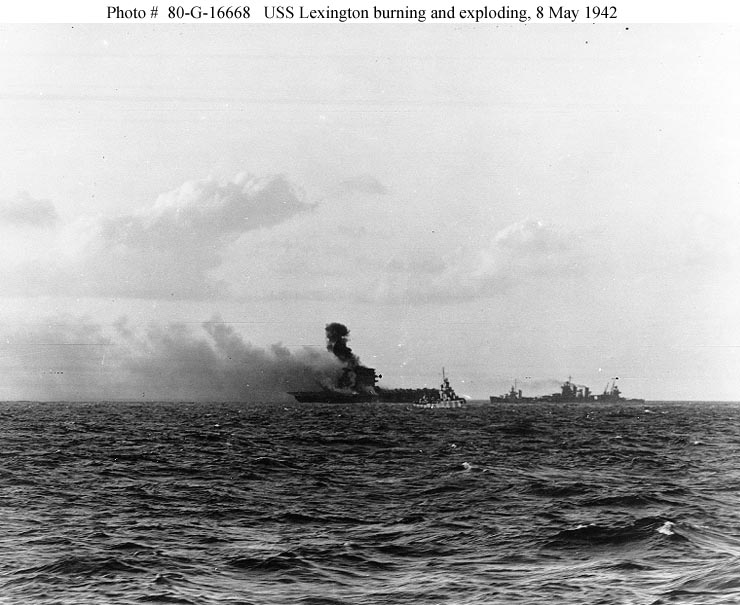
Figure 3: Explosion taking place amidships on board USS Lexington (CV-2) during the Battle of the Coral Sea on 8 May 1942. This is probably the explosion at 1727 hrs that took place as the carrier's abandonment was nearing its end. Ships standing by include the cruiser Minneapolis (CA-36) and destroyers Morris (DD-417), Anderson (DD-411) and Hammann (DD-412). Official US Navy Photograph, now in the collections of the National Archives. Click on photograph for larger image.


Figure 4: A heavy explosion on board USS Lexington (CV-2) blows an aircraft over her side on 8 May 1942 during the Battle of the Coral Sea. This is probably the "great explosion" from the detonation of torpedo warheads stowed in the starboard aft side of the hangar that followed an explosion amidships at 1727 hrs. At left is USS Hammann (DD-412), which was backing away with a load of the carrier's survivors on board. Photographed from USS Minneapolis (CA-36). Official US Navy Photograph, now in the collections of the National Archives. Click on photograph for larger image.


Figure 5: Diorama by Norman Bel Geddes depicting USS Hammann (DD-412) alongside USS Yorktown (CV-5) assisting her salvage team during the Battle of Midway, immediately before both ships were torpedoed by Japanese submarine I-168 on 6 June 1942. Official US Navy Photograph, now in the collections of the National Archives. Click on photograph for larger image.


Figure 6: Diorama by Norman Bel Geddes depicting the torpedoing of USS Hammann (DD-412) and USS Yorktown (CV-5) during the Battle of Midway by Japanese submarine I-168, during the afternoon of 6 June 1942. Official US Navy Photograph, now in the collections of the National Archives. Click on photograph for larger image.


Figure 7: USS Hammann (DD-412) sinking with stern high after being torpedoed by Japanese submarine I-168 on the afternoon of 6 June 1942 during the Battle of Midway. Photographed from the starboard forecastle deck of USS Yorktown (CV-5) by Photographer 2nd Class William G. Roy. Angular structure in right foreground is the front of Yorktown's forward starboard 5-inch gun gallery. Note knotted lines hanging down from the carrier's flight deck, remaining from her initial abandonment on 4 June. Official US Navy Photograph, now in the collections of the U.S. National Archives. Click on photograph for larger image.


Figure 8: USS Hammann (DD-412) disappears beneath the waves after being torpedoed by Japanese submarine I-168 in the afternoon of 6 June 1942 during the Battle of Midway. Photographed from the starboard forecastle deck of USS Yorktown (CV-5) by Photographer 2nd Class William G. Roy. Official US Navy Photograph, now in the collections of the U.S. National Archives. Click on photograph for larger image.


Figure 9: Diorama by Norman Bel Geddes depicting the explosion of a torpedo from USS Hammann (DD-412) as she sank alongside USS Yorktown (CV-5) on the afternoon of 6 June 1942 during the Battle of Midway. Both ships were torpedoed by Japanese submarine I-168 while Hammann was assisting with the salvage of Yorktown. USS Vireo (AT-144) is shown at left, coming back to pick up survivors, as destroyers head off to search for the submarine. Official US Navy Photograph, now in the collections of the National Archives. Click on photograph for larger image.


Figure 10: Survivors of USS Hammann (DD-412) are brought ashore at Pearl Harbor from USS Benham (DD-397) a few days after their ship was sunk on 6 June 1942. Note Navy ambulance in left foreground, many onlookers, depth charge racks on Benham's stern and open sights on her after 5-inch gun mount. Official US Navy Photograph, now in the collections of the U.S. National Archives. Click on photograph for larger image.


Figure 11: Commander Arnold E. True, USN, receives the Navy Cross and Distinguished Service Medal for his performance while in command of USS Hammann (DD-412) during the May-June 1942 Battles of the Coral Sea and Midway. Hammann was lost on 6 June 1942, during the Battle of Midway. Presenting the awards is Admiral William F. Halsey. Photograph was taken circa October 1942. Official US Navy Photograph, now in the collections of the U.S. National Archives. Click on photograph for larger image.


Named after Charles Hammann, a naval aviator during World War I who won the Medal of Honor, USS Hammann (DD-412) was a 1,620-ton Sims class destroyer that was built by the Federal Shipbuilding & Dry Dock Company at Kearny, New Jersey, and was commissioned on 11 August 1939. The ship was approximately 348 feet long and 36 feet wide, had a top speed of 35 knots, and had a crew of 241 officers and men. Hammann was armed with four 5-inch guns, eight 21-inch torpedo tubes, depth charges, and a number of smaller caliber anti-aircraft guns.

Hammann completed her shakedown cruise off America’s east coast and for two years participated in various naval exercises. Hammann was docked at Iceland when the war began for the United States on 7 December 1941. She quickly was ordered to proceed to Norfolk, Virginia, for fuel and supplies and on 6 January 1942 left for the Pacific via the Panama Canal. The ship arrived at San Francisco, California, on 22 January and then left on 25 February to join Rear Admiral Frank Jack Fletcher’s Task Force 17 that was heading for the South Pacific.

After completing some training exercises off the coast of New Caledonia in early March 1942, Hammann and Task Force 17 left for the Coral Sea. Hammann’s primary duty was to screen and escort the carrier USS Lexington (CV-2). Task Force 17 collided with the Japanese fleet during the Battle of the Coral Sea, which was fought from 7 to 8 May 1942. During the battle, Hammann provided close escort and anti-aircraft support for Lexington and repeatedly fired all of her guns at the oncoming Japanese planes. After fighting off an attack from Japanese torpedo planes, enemy dive bombers arrived on the scene. A bomb hit the ocean barely 200 yards off Hammann’s starboard bow. Unfortunately, Lexington sustained both torpedo and bomb hits and had to be abandoned. After the order was given to “Abandon Ship,” the destroyers Hammann, USS Morris (DD-417), and USS Anderson (DD-411) moved in to pick up survivors. This was done even though Lexington was burning furiously and was going to explode at any minute. And even after several major explosions wracked the doomed carrier, the destroyers continued their rescue efforts. Hammann alone picked up almost 500 men from the water before Lexington finally sank later that evening. Although Lexington was lost during the Battle of the Coral Sea, the US Navy sank one Japanese carrier, seriously damaged another, and forced yet another Japanese carrier to leave the area due to the large number of aircraft she lost during the battle. This was the first battle in naval history fought between aircraft carriers and it was technically a draw. But because of this confrontation, the Japanese Navy was unable to continue its expansion in the South Pacific and Australia was saved from isolation and possible invasion.

After the Battle of the Coral Sea, Hammann returned to Pearl Harbor with the surviving American warships, arriving there on 27 May 1942. The US Navy had broken the Japanese naval code and had obtained information that a major Japanese attack was going to be made on Midway Island in the central Pacific. Admiral Chester Nimitz, Commander-in-Chief of the US Pacific Fleet, ordered three of his remaining aircraft carriers to steam for Midway to intercept the Japanese fleet. It was a huge gamble because if the American carriers were lost, there wouldn’t be much left of the US Pacific fleet to stop the Japanese from going wherever they pleased, including Hawaii. Nimitz, therefore, ordered his carrier task forces to leave Pearl Harbor by 30 May, only three days after most of his ships had returned from the Battle of the Coral Sea.

What followed was the monumental Battle of Midway (4 to 7 June 1942). Hammann was given the task of escorting and screening the carrier USS Yorktown (CV-5). During the battle on 4 June, Hammann assisted Yorktown in fending off numerous Japanese air attacks. All the ships in the task force put up a wall of anti-aircraft fire to prevent the Japanese aircraft from hitting the American carriers. Unfortunately, there were simply too many attacking Japanese aircraft and several of them made it through the American defenses. USS Yorktown was hit by three bombs and two torpedoes. As the carrier burned and listed heavily, the order to “Abandon Ship” was given on board Yorktown. Once again, Hammann was given the task of assisting a sinking carrier. The destroyer moved in and quickly pulled a number of survivors out of the water. One of Hammann’s lifeboats even transferred Yorktown’s commanding officer, Captain Elliott Buckmaster, to another warship.

But Yorktown refused to sink, so efforts were made to salvage the carrier. On 6 June, Hammann came alongside Yorktown to place a repair party on board the carrier. A skeleton crew was already on board Yorktown and they were preparing the ship to be towed to safety. As Hammann was tied next to Yorktown, she provided the stricken carrier with fire hoses, water pressure, and some electrical power for the salvage crew. Good progress was being made to save Yorktown from sinking when, at 1536 hours on 6 June, the Japanese submarine I-168 penetrated Yorktown’s escort screen and fired four torpedoes at Hammann and Yorktown. One of the torpedoes missed, but two of them went under Hammann’s keel and hit Yorktown, while the fourth torpedo hit Hammann directly amidships. Massive explosions rocked both ships, but, while Yorktown remained afloat, Hammann was split completely in two. Debris from the explosions cascaded down on the two ships as both sections of the doomed destroyer drifted away from Yorktown. What was left of Hammann’s crew after the explosion quickly lowered life rafts into the water and tried to get away from the sinking ship. But the two pieces of the destroyer sank in four minutes, taking many of her crew with her. Then, shortly after the stern section of the ship sank, a huge underwater explosion occurred, probably due to one of the destroyer’s torpedoes blowing up. Some of the men who made it off the ship and into the water were killed by this explosion. Out of a crew of 241 officers and men, 81 were lost. Historian Samuel Eliot Morison stated that, “One hero of Hammann was Berlyn M. Kimbrell, who rechecked all the depth charges on ‘safe’ after the torpedo hit, made men on the fantail put on life jackets, shoved them overboard, and was the last to leave. He was killed by the underwater explosion. Commander Arnold E. True, the skipper, was picked up by USS Balch more dead than alive four hours after the explosion. He had been supporting in the water two seamen who were already dead when recovered, and all three were heavily covered with fuel oil.” The amazing Yorktown stubbornly stayed afloat until 7 June, when she finally gave up her struggle, capsized, and sank.

USS Hammann took part in two of the most important naval battles of World War II. But Hammann also showed how dangerous it was to stop in the middle of a battle to try and assist another ship in need. It was a tragic loss, but Midway turned out to be a major victory for the United States.

Tuesday, August 3, 2010

USS Dolphin (PG-24)


Figure 1: USS Dolphin (PG-24) is depicted in her as-built rig in a lithograph produced for the Los Angeles Daily Herald. The art was one in a set of eight illustrations the newspaper offered for a month's advance subscription. Price: 75 cents. US Naval Institute Photo Archive image from the April 2008 edition of Naval History magazine. Click on photograph for larger image.


Figure 2: USS Dolphin (PG-24) photographed during the 1890s. US Naval Historical Center Photograph. Click on photograph for larger image.


Figure 3: “Homecoming of the Great White Fleet," Hampton Roads, Virginia, on 22 February 1909. Yachts and other vessels welcome the fleet upon its arrival to Hampton roads. The large yacht in the right distance is USS Mayflower, which had President Theodore Roosevelt embarked. The steamer on the left, with three masts, is USS Dolphin. She carried members of Congress during the welcoming ceremonies. US Naval Historical Center Photograph. Click on photograph for larger image.


Figure 4: Cutter race among the crews of the Squadron of Evolution's ships, in Boston Harbor, Massachusetts, 29 November 1889. The squadron then consisted of the cruisers Chicago, Boston and Atlanta, gunboat Yorktown and dispatch vessel Dolphin. Courtesy of Doctor Henry P. Walker, 1975. US Naval Historical Center Photograph. Click on photograph for larger image.


Figure 5: USS Dolphin (PG-24) docked at the western end of the Washington Navy Yard waterfront, District of Columbia, circa 1901. The view looks north. The old experimental battery building is at the right. The original glass plate negative is # 19-N-24-2-24 in the collections of the National Archives. Plate # 19-N-24-3-5 is a very similar view. US Naval Historical Center Photograph. Click on photograph for larger image.


Figure 6: A view of USS Dolphin (PG-24) looking forward from the bridge, taken while the ship was at sea in February 1916. Note ice accumulated on deck and lifelines. The original image is printed on postal card stock. Donation of Dr. Mark Kulikowski, 2005. US Naval Historical Center Photograph. Click on photograph for larger image.


Figure 7: USS Dolphin (PG-24) at Galveston, Texas, 1 March 1919. Photographed by Paul Verkin, Galveston. Note that the ship is still wearing pattern camouflage nearly four months after the World War I Armistice. Donation of Dr. Mark Kulikowski, 2007. US Naval Historical Center Photograph. Click on photograph for larger image.


The 1,485-ton USS Dolphin was one of the first ships built for America’s Steel Navy. Called the “ABCD ships” (for Atlanta, Boston, Chicago, and Dolphin), these were the first four ships made of steel for the “New Navy,” as it eventually became known in the 1880s. Dolphin was designed as a dispatch vessel, a ship that could quickly carry messages to naval bases and to other naval warships at sea. It was an important job during the days of elementary naval communications. Dolphin was built by John Roach & Sons at Chester, Pennsylvania, and was commissioned on 8 December 1885, the first of the ABCD ships to enter service. Dolphin was approximately 256 feet long and 32 feet wide, had a top speed of 16 knots, and had a crew of 152 officers and men. Although never intended to be a warship, let alone a gunboat, the ship was armed with two 4-inch guns and two six-pounder rapid-fire guns.

Dolphin initially was assigned to the North Atlantic Station and patrolled off America’s east coast until February 1888. She then went on an incredible around-the-world cruise, steaming first around the tip of South America and entering the Pacific Ocean. Dolphin went on to visit ports in Japan, Korea, China, Ceylon, India, Arabia, and Egypt, and then entered the Mediterranean via the Suez Canal and made stops in Italy, Spain, and England. After moving on to the Madeira Islands and then Bermuda, Dolphin reached New York on 27 September 1889 after completing a 58,000-mile journey around the world. The trip was used as an opportunity to show the world America’s new steel and steam technologies and it also demonstrated how tough and efficient our new ships were. Dolphin’s engine was shut down for less than two hours during the entire trip for maintenance purposes and no problems were experienced with the steel hull. Dolphin proved that the quality of the new steel ships being produced in the United States was excellent and that the US Navy had successfully entered this new era of warship construction.

After the trip, Dolphin returned to the North Atlantic Station and patrolled around the West Indies from December 1889 to June 1890. On 23 December 1890, Dolphin was assigned to the “Squadron of Evolution,” the experimental task force that consisted of all of the ABCD ships. The Squadron of Evolution was created by the US Navy as a training tool to teach a new generation of officers and sailors how to operate modern steel warships. New naval tactics also were specifically created for these warships and guidelines were established for the care and maintenance of these vessels. Dolphin remained with the Squadron of Evolution until 7 April 1891.

Dolphin was placed out of commission at Norfolk, Virginia, on 1 May 1891 but was re-commissioned on 14 March 1892. She patrolled along the Atlantic coast of the United States and on many occasions served as a transport for the Secretary of the Navy. Dolphin was sent on a surveying expedition to Guatemala from January to February 1896 and she carried President William McKinley to New York City for the ceremonies at Grant’s Tomb on 23 April 1897. Dolphin again was placed out of commission in New York on 23 November 1897.

Re-commissioned on 24 March 1898, just prior to the start of the Spanish-American War, Dolphin eventually was sent to Cuba and was part of the US Naval blockade of Havana during April and May. On 6 June, Dolphin was fired on by the Morro Battery at Santiago, Cuba, but later that month she steamed back to Norfolk, arriving there on 2 July.

From 1899 to 1914, Dolphin served on many occasions as a special dispatch ship for the Secretary of the Navy. She also carried the president of the United States as well as other important officials and diplomats. In August 1905, Dolphin carried Japanese diplomats from Oyster Bay, New York, to Portsmouth, New Hampshire, to attend the peace conference (which was brokered by President Theodore Roosevelt) that ended the Russo-Japanese War. Dolphin continued to be used for ceremonial duties until 22 October 1908, when she became the flagship of the Third Squadron of the Atlantic Fleet. In this capacity, she patrolled the West Indies and assisted in the occupation of Santo Domingo from 12 to 22 May 1916.

Dolphin left Washington, DC, on 2 April 1917 to take possession of the Virgin Islands, which had recently been purchased by the United States. Four days later, the United States declared war on Germany, officially entering World War I. On 7 April, Dolphin arrived at St. Thomas and on 9 April, the United States officially took over the islands. On 26 April, Dolphin searched for the steamer Nordskar, ostensibly a Danish vessel, which was suspected of assisting German ships in the area. Dolphin located Nordskar at St. Lucia on 5 May. Dolphin kept Nordskar in custody until she was able to turn the merchant ship over to British authorities on 28 June. Dolphin then went to Key West, Florida, and patrolled the Caribbean until returning to Washington, DC, on 6 September 1917.

Dolphin became the flagship for the American Patrol Detachment on 17 September 1917 and was based at Key West. She patrolled the Gulf of Mexico and the Caribbean and protected merchant shipping there until the end of the war. Dolphin remained in the Caribbean until 25 June 1920, when she left for New York. Dolphin was designated a Patrol Gunboat (PG-24) on 17 July 1920 and, after being sent to Boston, Massachusetts, for an overhaul, Dolphin left on 16 October 1920. She was assigned to Balboa, Panama, for target practice and hydrographic experiments, and was ordered to travel to neighboring countries for “good-will” visits. On 16 September 1921, Dolphin went to Puerto Barrios, Guatemala, to attend the anniversary of Guatemalan independence.

Dolphin returned to Boston on 14 October 1921. This proud little ship, the first to be commissioned into America’s New Steel Navy, was decommissioned for the last time on 8 December 1921. USS Dolphin was sold for scrapping on 25 February 1922 after almost 40 years of service in the US Navy.

Tuesday, July 27, 2010

USS Sicily (CVE-118, later AKV-18)


Figure 1: USS Sicily (CVE-118) photographed while moored in Hampton Roads, Virginia, 6 June 1948. Courtesy of Donald M. McPherson, 1969. US Naval Historical Center Photograph. Click on photograph for larger image.


Figure 2: USS Sicily (CVE-118) enters San Diego Bay on her return from her first deployment to the Korean War zone, 5 February 1951. Her crew spells out the ship's name on the flight deck. US Navy photograph. Click on photograph for larger image.


Figure 3: USS Sicily (CVE-118) launches a US Marine Corps OY-2 "Sentinel" spotter plane during operations in the Yellow Sea off the west coast of Korea, 22 September 1950. Sicily was then supporting the campaign to recapture Seoul. Official US Navy Photograph, now in the collections of the National Archives. Click on photograph for larger image.


Figure 4: US Marine Corps F4U-4B "Corsair" fighter-bomber receives final checks to its armament of bombs and 5-inch rockets, just prior to being catapulted from USS Sicily (CVE-118) for a strike on enemy forces in Korea. The original photograph is dated 16 November 1950, but was probably taken in August-October 1950. Note battered paint on this aircraft. Official US Navy Photograph, now in the collections of the National Archives. Click on photograph for larger image.


Figure 5: USS Sicily (CVE-118) launches US Marine Corps HRS-1 helicopters during Operation "Marlex-5" off the west coast of Korea in the Inchon area. This was the first time that Marine Corps landing forces had moved from ship to shore by helicopter. Photo is dated 1 September 1952. Nearest HRS-1 is Bureau # 127798. It wears the markings of squadron HMR-161. Official US Navy Photograph, now in the collections of the National Archives. Click on photograph for larger image.


Figure 6: USS Sicily (CVE-118) photographed at the Yokosuka Naval Base, Japan, circa February 1954, with USS Yorktown (CVA-10) at right and eleven LCM landing craft in the foreground. Grumman AF "Guardian" anti-submarine aircraft are parked on Sicily's flight deck. Douglas AD "Skyraider" attack planes are parked aft on Yorktown's flight deck. The original caption, released by Commander Naval Forces Far East on 18 February 1954, reads: "Twins, Almost -- The Essex-class carrier USS Yorktown (CVA-10) and her smaller counterpart, the escort carrier USS Sicily (CVE-118), rest side by side during a recent in-port maintenance period at the Yokosuka, Japan, Naval Base." Official US Navy Photograph, from the collections of the Naval Historical Center. Click on photograph for larger image.


Figure 7: USS Sicily (CVE-118) underway with F4U aircraft parked aft, April 1954. Official US Navy Photograph, from the collections of the Naval Historical Center. Click on photograph for larger image.


Figure 8: USS Perkins (DDR-877) escorting USS Sicily (CVE-118) off the coast of Korea, 26 August 1951. Perkins was photographed from Sicily. Official US Navy Photograph, from the collections of the Naval Historical Center. Click on photograph for larger image.


USS Sicily (CVE-118) was a 10,900-ton Commencement Bay class escort aircraft carrier that was built by Todd-Pacific Shipyards Inc. at Tacoma, Washington, and was commissioned on 27 February 1946. The ship was approximately 557 feet long and 75 feet wide, had a top speed of 19 knots, and had a crew of 1,170 officers and men. Sicily was armed with two 5-inch guns, 36 40-mm. guns, and 18 20-mm. guns, and could carry roughly 33 aircraft (depending on the size of the aircraft).

After fitting out in Portland, Oregon, and being loaded with supplies at Seattle, Washington, Sicily steamed to San Diego, California, for her shakedown training. On 15 May 1946, Sicily left for New York via the Panama Canal. The escort carrier reached the Brooklyn Navy Yard in New York City on 6 June and stayed there until 30 September, when she was ordered to Argentia, Newfoundland, for cold weather naval exercises.

For the rest of 1946 and until 3 April 1950, Sicily was assigned to the US Navy’s Atlantic Fleet and was based at Norfolk, Virginia. She was then transferred back to the Pacific Fleet and was sent to her new base at San Diego, arriving there on 28 April. After North Korea invaded South Korea on 25 June 1950, Sicily was ordered to join the fight. She received orders on 2 July to steam to the Far East and left port two days later. This was the first of three deployments to Korea during the war there. Sicily initially was sent to provide anti-submarine protection for American ships off the coast of Korea, but this quickly changed as the situation deteriorated rapidly on shore. Marine Corps aircraft that were carried on board the ship soon provided air support for American ground forces defending the famous “Pusan Perimeter” and assisting in the amphibious attack on Inchon on 15 September 1950. During October and November, Sicily’s aircraft temporarily resumed their anti-submarine duties. But in December, her aircraft were once again needed for ground support after China entered the war and launched a major offensive against the United Nations’ forces. Marine Corps aircraft from Sicily also made valiant efforts to assist their fellow Marines during their horrific retreat from the Chosin Reservoir.

Sicily returned to San Diego on 5 February 1951. The ship’s second tour of duty off Korea lasted from 13 May to 12 October 1951. She patrolled off both the east and west coasts of Korea before returning once again to the United States for an overhaul. Sicily’s final tour of duty during the Korean War lasted from 8 May to 4 December 1952. During this deployment, the escort carrier was equipped with Marine Corps helicopters that conducted some of the first experiments in sea-based vertical assault techniques. During Operation "Marlex-5" off the west coast of Korea in the Inchon area, Marines were airlifted from Sicily to shore by helicopter. This was the first time a Marine Corps landing force was transported from ship to shore using helicopters.

After returning to the United States for another overhaul, Sicily was sent back to the Far East for the last time on 14 July 1953 and remained there until 25 February 1954. Sicily was decommissioned shortly after the end of this deployment and spent the rest of her career in the Pacific Reserve Fleet. The escort carrier was reclassified an aircraft transport (AKV-18) in May 1959, but in October 1960 USS Sicily was sold for scrapping. The ship received five battle stars for her service during the Korean War.

Tuesday, July 20, 2010

USS Macdonough (DD-351)


Figure 1: USS Macdonough (DD-351) off the Boston Navy Yard, 14 June 1935. Official US Navy Photograph, from the collections of the Naval Historical Center. Click on photograph for larger image.


Figure 2: USS Macdonough (DD-351) steaming in another destroyer's wake during maneuvers staged for Movietone News off San Diego, California, by Destroyer Squadron Twenty (DesRon 20), 14 September 1936. Courtesy of Commander Robert L. Ghormley, Jr., USN, 1969. US Naval Historical Center Photograph. Click on photograph for larger image.


Figure 3: USS Macdonough (DD-351) steaming in another destroyer's wake during an exhibition staged for Movietone News by Destroyer Squadron Twenty (DesRon 20) off San Diego, California, 14 September 1936. Courtesy of Commander Robert L. Ghormley, Jr., USN, 1969. US Naval Historical Center Photograph. Click on photograph for larger image.


Figure 4: USS Macdonough (DD-351) at sea, circa 1935-1937. Official US Navy Photograph, from the collections of the Naval Historical Center. Click on photograph for larger image.


Figure 5: USS Macdonough (DD-351) underway at sea, circa 1935-1937. US Naval Historical Center Photograph. Click on photograph for larger image.


Figure 6: USS Macdonough (DD-351) approaching an anchorage in the lower end of Iliuliuk Bay, off Rocky Point, in the Aleutian Islands, 27 April 1937. Photographed from USS Dewey (DD-349). US Naval Historical Center Photograph. Click on photograph for larger image.


Figure 7: USS Macdonough (DD-351) underway in a harbor, 11 April 1938. US Naval Historical Center Photograph. Click on photograph for larger image.


Figure 8: View of USS Macdonough’s (DD-351) starboard side, forward, while she was at the Mare Island Navy Yard, California, on 29 May 1942. Note details of motor boat (lower left), pilothouse, and main battery gun director. Photograph from the Bureau of Ships Collection in the US National Archives. Click on photograph for larger image.


Figure 9: USS Macdonough (DD-351) off the Mare Island Navy Yard, California, 17 January 1943. Photograph from the Bureau of Ships Collection in the US National Archives. Click on photograph for larger image.


Figure 10: USS Macdonough (DD-351) off the Mare Island Navy Yard, California, 3 September 1943. Photograph from the Bureau of Ships Collection in the US National Archives. Click on photograph for larger image.


Figure 11: USS Macdonough (DD-351) at sea in December 1943. Place unknown. Official US Navy Photograph, now in the collections of the National Archives. Click on photograph for larger image.


Named after Commodore Thomas Macdonough (1783-1825), a famous US naval hero from the War of 1812, USS Macdonough (DD-351) was a 1,395-ton Farragut class destroyer that was built by the Boston Navy Yard at Boston, Massachusetts, and was commissioned on 15 March 1935. The ship was approximately 341 feet long and 34 feet wide, had a top speed of 36 knots, and had a crew of 160 officers and men. Macdonough was armed initially with five 5-inch guns, four .30-caliber machine guns, eight 21-inch torpedo tubes, and depth charges, although this armament was modified during World War II.

After a shakedown cruise that took her to Europe and western South America, Macdonough was assigned to the US Pacific Fleet and was based at San Diego, California, until 12 October 1939. She was then moved to Pearl Harbor, Hawaii, and joined Destroyer Squadron 1. Macdonough was at Pearl Harbor during the attack on 7 December 1941 and managed to shoot down one of the attacking Japanese aircraft. Undamaged during the attack, Macdonough left Pearl Harbor and joined the few remaining US warships that went searching for the Japanese task force. Unable to locate the enemy, the American warships returned to their shattered naval base and for the next three months Macdonough was used to patrol the waters southwest of Oahu, Hawaii. Macdonough also escorted convoys between America’s west coast and Hawaii and she was assigned to patrol and escort duties in the south Pacific as well, primarily around New Guinea.

Macdonough participated in the invasion of Guadalcanal and Tulagi in the Solomon Islands on 7 August 1942. She also was part of the doomed American task force during the Battle of Savo Island, where several Allied cruisers were lost in a single night. Macdonough, though, escaped unharmed from this tragic encounter. At the end of September, Macdonough began escorting ships between New Guinea, Espiritu Santo (in the New Hebrides), and Pearl Harbor and continued these duties until the end of December 1942, when she was sent to Mare Island, California, for an overhaul.

Macdonough’s next mission was to participate in the invasion of Attu Island in the Aleutians. She arrived at Adak, Alaska, on 16 April 1943 and patrolled the waters northeast of Attu in preparation for the invasion, which was scheduled to begin on 11 May. But on 10 May, Macdonough was hit by the merchant ship Sicard while escorting the attack transports in bad weather. As a result of the collision, the destroyer was forced to return to port under tow. Macdonough returned to Mare Island for repairs and remained there until 23 September 1943.

After being repaired, Macdonough participated in the invasion of Makin Island in the Gilbert Islands on 20 November 1943, acting as a control ship for landing craft and bombarding Japanese targets on shore. On 23 November, the battle for Makin Island ended and Macdonough returned to Pearl Harbor. Macdonough continued escorting ships during the invasion of the Marshall Islands from January to February 1944 and on 15 February, while patrolling off Kwajalein Atoll, Macdonough assisted in sinking a Japanese submarine, RO-40.

Once the campaign in the Marshall Islands was over, Macdonough was assigned to the central Pacific and to amphibious assaults in New Guinea. On 30 April 1944, Macdonough assisted in the destruction of another Japanese submarine (RO-45) off the island of Truk. Macdonough participated in the invasion of the Marianas Islands from early June until early August 1944 and her major duties included bombarding enemy targets on shore, supporting underwater demolition teams, conducting anti-submarine patrols, and escorting carrier task forces. Later that year, Macdonough was part of the invasion of the Philippine Islands and escorted a number of transports during the Battle for Leyte Gulf on 24 and 25 October. Macdonough continued her escort duties until January 1945, when she went to the Puget Sound Navy Yard, Washington, for a badly needed three-month overhaul. Once the overhaul was completed, Macdonough served as a radar picket ship and escort in the central and western Pacific, mainly between Ulithi Atoll in the Caroline Islands and Okinawa, Japan.

Macdonough found herself at Guam when the war ended in the Pacific. She returned to the United States and arrived at San Diego on 3 September 1945. After stopping briefly at San Diego, Macdonough continued her voyage to the New York Navy Yard on America’s east coast. She was decommissioned there on 22 October 1945 and was sold for scrapping on 20 December 1946. USS Macdonough received a hefty 13 battle stars for her service during World War II.