Tuesday, June 15, 2010

USS Boxer (CV-21/CVA-21/CVS-21/LPH-4)


Figure 1: USS Boxer (CV-21) slides down the building ways, during launching ceremonies at the Newport News Shipbuilding & Dry Dock Company, Newport News, Virginia, 14 December 1944. Note banner spread across the front of Boxer's flight deck, proclaiming: "Here We Go to Tokyo! Newport News Shipyard Workers' War Bonds Help to Sink the Rising Sun." Courtesy of William H. Davis. US Naval Historical Center Photograph. Click on photograph for larger image.


Figure 2: US personnel wait to board USS Boxer (CV-21) at Alameda, California, for a fast trip to Japan, circa 8-14 July 1950. On 14-22 July, the ship carried an emergency shipment of 170 Air Force and Navy aircraft, plus personnel and equipment, to the Korean War zone in a record 8 1/2 day trans-Pacific crossing. Two of the 145 USAF F-51 Mustang fighters carried are visible on her flight deck. Official US Navy Photograph, from the "All Hands" collection at the Naval Historical Center. Click on photograph for larger image.


Figure 3: USS Boxer (CV-21), with her crew spelling out her name on the flight deck, steams past the Golden Gate Bridge into San Francisco Bay as she returned from her first Korean War deployment, November 1950. Official US Navy Photograph, from the collections of the Naval Historical Center. Click on photograph for larger image.


Figure 4: A crash landing on board USS Boxer (CV-21), circa 1947. This appears to be an AD-1 Skyraider from squadron VA-20A. Courtesy Rhonda Gross, daughter of C.E. "Red" Gorham Jr. (USN). Click on photograph for larger image.


Figure 5: Another view of a crash landing on board USS Boxer (CV-21), circa 1947. This appears to be an AD-1 Skyraider from squadron VA-20A. Courtesy Rhonda Gross, daughter of C.E. "Red" Gorham Jr. (USN). Click on photograph for larger image.


Figure 6: Four F9F-2 "Panther" jet fighters roar past the USS Boxer (CV-21), with dive brakes, landing gear and arresting hooks down, preparing to land on board after returning from a mission over North Korea, 23 June 1951. The planes and their pilots are from Fighter Squadron 721 (VF-721), a Naval Reserve squadron formerly based at Naval Air Station, Glenview, Illinois. Official US Navy Photograph, from the collections of the Naval Historical Center. Click on photograph for larger image.


Figure 7: "Plane Captain Felix A. Norris, USNR, aids in strapping in the pilot of his Corsair fighter. Soon the deadly Corsair will be diving on an enemy bridge or supply dump in North Korea, pinpointing its targets with bombs, napalm and rockets." The pilot is Lieutenant (jg) John W. White, Jr. Note the Confederate flag patch on his right shoulder, signifying the Memphis 'Rebel' squadron." This photograph and caption were released by USS Boxer on 27 June 1951, but the photo was taken on 26 June. Boxer carried two squadrons of F4U Corsair fighters at this time, VF-791 and VF-884. Both were Naval Reserve units reactivated for Korean War service. Official US Navy Photograph, from the "All Hands" collection at the Naval Historical Center. Click on photograph for larger image.


Figure 8: "Deck Launch -- Visible rings of vapor encircle a Corsair fighter as it turns up prior to being launched from the USS Boxer for a strike against communist targets in Korea. Hovering to the stern of the aircraft carrier, the ever-present helicopter plane guard stands by to assist if any emergency arises." Photograph and caption were released in Washington, DC, on 20 July 1951. Planes are Vought F4U-4s. Helicopter is a Sikorsky HO3S. Official US Navy Photograph, from the collections of the Naval Historical Center. Click on photograph for larger image.


Figure 9: Some of USS Boxer‘s(CV-21) F4U Corsair fighters and AD Skyraider attack planes rendezvous off the North Korean coast. Photo is dated 15 August 1951. The F4U in the foreground is from squadron VF-791. ADs are from squadron VA-702. Official US Navy Photograph, now in the collections of the National Archives. Click on photograph for larger image.


Figure 10: Two F4U-5N Corsair fighters of squadron VC-3 fly past USS Boxer (CV-21) during combat operations off Korea. Photo is dated 4 September 1951. These planes are Bureau #s 124537 (left) and 124539. Their pilots are Lieutenant John D. Ely, USNR, and Lieutenant (JG) J.G. Stranlund, USNR. Official US Navy Photograph, now in the collections of the National Archives. Click on photograph for larger image.


Figure 11: North Korean railroad bridges after they were destroyed by Navy carrier planes, 3 October 1951. The main bridge has several spans down. Its bypass, to the left of the main bridge, has been destroyed over much of its length. Note heavy craters in the riverbed near the bridges, made by different sized bombs. This photograph was taken by a plane from USS Boxer (CV-21). Official US Navy Photograph, now in the collections of the National Archives. Click on photograph for larger image.


Figure 12: Admiral Arthur W. Radford, USN, Commander-in-Chief Pacific (left), on board USS Boxer (CV-21), during his helicopter tour of ships operating off North Korea. Also present are Captain Dennis J. Sullivan, the carrier's Commanding Officer (center), and Commander James O'Grady. Photo is dated 28 April 1952. Official US Navy Photograph, now in the collections of the National Archives. Click on photograph for larger image.


Figure 13: "Practice is Important -- Commander Gordon Sherwood ..., commanding officer of Attack Squadron 65, hangs in parachute harness from an A frame erected on the hanger deck of the Boxer. With the help of the apparatus, he perfects the technique of getting out of the harness in the least possible time after landing. Seconds saved sometimes mean the difference between life and death to a downed pilot." Photograph and caption were released by Commander Naval Forces, Far East, on 1 August 1952. Boxer, with VA-65 embarked, was then operating off Korea. Official US Navy Photograph, from the "All Hands" collection at the Naval Historical Center. Click on photograph for larger image.


Figure 14: Hangar deck fire on board USS Boxer (CV-21) that took place on 5 August 1952. Ordnance men strip live 20-mm ammunition from a damaged F9F Panther jet fighter, while firefighters bring the blaze under control. Boxer was then operating off Korea. Official US Navy Photograph, now in the collections of the National Archives. Click on photograph for larger image.


Figure 15: Task Force 77 replenishing during operations off Korea. The carrier in the foreground is USS Boxer (CVA-21), taking on fuel from an oiler which is also fueling a destroyer. Two other carriers, several destroyers and another replenishment ship are in the background. Photograph is dated 2 June 1953. Official US Navy Photograph, now in the collections of the National Archives. Click on photograph for larger image.


Figure 16: USS Boxer (CVA-21) operating off North Korea in July 1953. Her flight deck crew is re-spotting aircraft in preparation for recovery of her last strike. Another aircraft carrier and the battleship USS New Jersey (BB-62) are steaming ahead of Boxer. Official US Navy Photograph, now in the collections of the National Archives. Click on photograph for larger image.


Figure 17: “USS Boxer (CVA-21) Tribute -- While F9F Panther jets rest on the catapults in readiness, officers and men of the carrier USS Boxer pay tribute to pilots and crewmembers of the ship who gave their lives during the Korean War." Photograph and caption were released by Commander Naval Forces Far East on 9 August 1953. Plane on the port catapult is a Grumman F9F of Fighter Squadron 151 (VF-151). Official US Navy Photograph, from the collections of the Naval Historical Center. Click on photograph for larger image.


Figure 18: USS Boxer (CVA-21) in port, 18 November 1953. Picture was probably taken in San Francisco Bay, California, upon her return from the Far East. US Naval Historical Center Photograph. Click on photograph for larger image.


Figure 19: USS Boxer’s (CVA-21) crewmembers spell out "Boxer 75,000 Landings" on the flight deck to commemorate reaching that milestone in her career. The landing was made on 19 November 1955 by Lieutenant (Junior Grade) Charles R. Smith, and his crewman, Roland W. Parker, flying an AD Skyraider of Composite Squadron 35. The original photograph was released by Commander Naval Forces Far East on 28 November 1955. Official US Navy Photograph, from the collections of the Naval Historical Center. Click on photograph for larger image.


Figure 20: US Marine Corps HUS-1 helicopters lift off USS Boxer‘s (LPH-4) flight deck during operations off Vieques Island with the Tenth Provisional Marine Brigade, 8 March 1959. Photograph by Grantham. Official US Navy Photograph, from the collections of the Naval Historical Center. Click on photograph for larger image.


Figure 21: USS Boxer (LPH-4) at Mayport, Florida, in August 1965, just prior to departing for Vietnam with elements of the Army's First Cavalry Division on board. She carried 1,200 personnel, 205 helicopters and 6 OV-1 airplanes to the combat zone. Aircraft on her flight deck include 6 OV-1 (dark colored-forward); 4 CH-54 (white-just forward of island); 56 CH-47 (dark colored-amidships and aft) and 36 UH-1 (white-amidships and forward). The remaining 109 helicopters are presumably stowed on Boxer's hangar deck. Official US Army Photograph, from the collections of the Naval Historical Center. Click on photograph for larger image.


Figure 22: "Caribbean Ready Group 1-68 steams in formation as it patrols the Caribbean Sea. Commanded by Capt. J.B. Drachnik, USN, Commander Amphibious Squadron Four, its mission is the promotion of peace and goodwill and the protection of US citizens and property ashore in time of crisis. Homeported in Norfolk, Virginia, the Group has been deployed since March. Ships of the Ready Group are: (l-r) Attack Cargo Ship, USS Rankin (AKA-103); Dock Landing Ship, USS Fort Snelling (LSD-30); Amphibious Assault Ship, USS Boxer (LPH-4); Tank Landing Ship, USS Graham County (LST-1176); and High Speed Transport, USS Kirwin (APD-90)." Photographed by PH2 A.P. Gonthier, Jr. The original photograph and caption were released by USS Boxer in 1968. Official US Navy Photograph, from the collections of the Naval Historical Center. Click on photograph for larger image.


Named after the brig HMS Boxer, which was captured by the US brig Enterprise in 1813, USS Boxer (CV-21) was a 27,100-ton Ticonderoga class aircraft carrier that was built by the Newport News Shipbuilding and Dry Dock Company at Newport News, Virginia, and was commissioned on 16 April 1945. The ship was approximately 888 feet long and 147 feet wide, had a top speed of 33 knots, and had a crew of 3,448 officers and men. Boxer was originally armed with 12 5-inch guns, 32 40-mm guns, and 46 20-mm guns, but this changed dramatically over the years due to the rise of missile technology. Boxer also carried 82 aircraft, but this also varied depending on the carrier’s mission.

Boxer was completed too late to participate in World War II, but she did join the Pacific Fleet at San Diego, California, in August 1945. From September 1945 to 23 August 1946, Boxer was based at Guam and served as the flagship of Task Force 77 in the western Pacific. The ship returned to San Francisco, California, on 10 September 1946 and for more than three years remained on America’s west coast, assigned to the usual peacetime duties and naval exercises that were common at that time. Boxer was sent back to the Far East on 11 January 1950 and was attached to the US Seventh Fleet for the first six months of 1950. She returned to San Diego on 25 June, the very day North Korea invaded South Korea.

With the start of the Korean War, Boxer was quickly loaded with aircraft, men, and supplies and sent back to the Far East. She was used as an aircraft transport and carried 170 Air Force and Navy aircraft, including more than 1,000 personnel and their equipment. Boxer left San Diego on 14 July 1950 and made a record crossing of the Pacific Ocean, arriving in the Korean War Zone on 22 July, a trip lasting only eight and one-half days. On her return trip to the west coast, which lasted from 27 July to 4 August, Boxer set another record, making the trip in only seven days, 10 hours, and 36 minutes.

After undergoing some repairs, Boxer returned to the Far East on 24 August 1950 and joined Task Force 77 once again. Her planes were used in the ground attack role, assisting the United Nations troops in stopping the North Koreans from advancing. Boxer’s planes also participated in the landing at Inchon on 15 September 1950. Boxer’s air groups continued providing air support for the ground troops until November, when she was ordered back to the west coast for an overhaul.

Boxer left San Diego for her second Korean War tour on 2 March 1951 and was again attached to Task Force 77. Her planes were once again primarily used in the ground-attack role, making numerous sorties in support of the beleaguered Allied troops in Korea. Boxer returned to San Francisco on 24 October 1951 and was sent back to Korea on 8 February 1952 for her third tour of duty. On 23 and 24 June, while attached to Task Force 77, Boxer’s planes participated in heavy attacks against North Korean hydro electric targets. But on 5 August 1952, a deadly fire raged on Boxer’s hanger deck, killing nine men and seriously injuring two others. After the crew managed to put out the fire, the ship steamed to Yokosuka, Japan, for emergency repairs that took from 11 to 23 August. After temporary repairs were completed, Boxer returned to the waters off Korea. But the ship was ordered back to San Francisco for more permanent repairs and arrived there on 25 September. The repairs were not fully completed until March 1953.

Boxer left for her fourth tour of duty in Korea on 30 March 1953 and her aircraft flew into action a month later. Boxer’s air groups participated in the final battles of the Korean War and the ship remained in the Far East until November 1953. During the post Korean War period, Boxer served as an attack carrier (CVA-21) for the Seventh Fleet for two cruises, once in 1954 and then from 1955 to 1956. After being converted into an anti-submarine warfare carrier (CVS-21) in early 1956, Boxer made her final cruise in that role in the western Pacific from 1956 to 1957.

In 1957, Boxer was converted once again, this time into an experimental helicopter assault aircraft carrier. In 1958, she also served as the flagship for Operation Hardtack, a nuclear weapons test program in the central Pacific. Later that same year, Boxer was transferred to the Atlantic Fleet as an Interim Amphibious Assault Ship and was formally re-designated LPH-4 on 30 January 1959.

For the next ten years, Boxer played a significant role as an amphibious assault ship for the US Navy. She carried Marines, along with their transport helicopters, and primarily operated in the Caribbean. Boxer participated in the 1962 Cuban Missile Crisis and in America’s intervention in the Dominican Republic in 1965. But in mid-1965, Boxer was sent into yet another war zone, this time to Vietnam. She was used as an aircraft transport and carried more than 205 US Army helicopters (including 1,200 Army personnel) and other aircraft to Vietnam as part of the deployment of the First Cavalry Division (Air Mobile). Boxer was also used as a spacecraft recovery vessel in early 1966 before making a second trip to Vietnam, this time carrying US Marine Corps aircraft and personnel. But the carrier was showing its age and other, newer, amphibious assault ships were joining the fleet. Boxer, therefore, was decommissioned in December 1969 and was sold for scrapping in February 1971.

Tuesday, June 8, 2010

USS Badoeng Strait (CVE-116/AKV-16)


Figure 1: USS Badoeng Strait (CVE-116) tied up at a tropical port, during the later 1940s or early 1950s. Official US Navy Photograph, from the collections of the Naval Historical Center. Click on photograph for larger image.


Figure 2: USS Badoeng Strait (CVE-116) underway on 6 August 1952, while en route to the Far East for her third, and final, Korean War deployment. Seven F4U Corsair fighter bombers are spotted on the forward end of her flight deck. The "LD" painted on their vertical stabilizers shows that they belong to Marine Fighter Squadron 212 (VMF-212). Official US Navy Photograph, from the collections of the Naval Historical Center. Click on photograph for larger image.


Figure 3: Grumman F6F Hellcat fighter is catapulted from USS Badoeng Strait (CVE-116), during operations in the eastern Pacific, circa early 1946. The carrier was then flagship of Commander Carrier Division 17, Rear Admiral Dixwell Ketcham. Collection of Vice Admiral Dixwell Ketcham. Official US Navy Photograph, from the collections of the Naval Historical Center. Click on photograph for larger image.


Figure 4: USS Badoeng Strait (CVE-116) loading Marine Corps F4U-4B Corsair fighters at Naval Air Station North Island, San Diego, California, for transportation to Korea, July 1950. Badoeng Strait carried planes and aircrew of Marine Air Group 33 as part of the trans-Pacific movement of the First Provisional Marine Brigade, the initial Marine Corps deployment of the Korean War. She left San Diego in mid-July and arrived at Kobe, Japan on 31 July, flying her planes off the following day. Official US Navy Photograph, from the collections of the Naval Historical Center. Click on photograph for larger image.


Figure 5: USS Badoeng Strait (CVE-116) crewmen clear snow from the carrier's flight deck during operations off the Korean coast, 14 November 1950. Planes on deck are Marine Corps F4U-4B Corsair fighters. Notice how narrow the flight deck seems with the Corsairs parked there. Official US Navy Photograph, from the collections of the Naval Historical Center. Click on photograph for larger image.


Figure 6: Marine Corps F4U-4B Corsair fighter parked on USS Badoeng Strait‘s (CVE-116) snowy flight deck during operations off the Korean coast, 14 November 1950. Official US Navy Photograph, from the collections of the Naval Historical Center. Click on photograph for larger image.


Figure 7: USS Badoeng Strait (CVE-116) crewmen use a power brush to sweep ice and snow from the carrier's flight deck during operations off the Korean coast, 30 November 1950. Official US Navy Photograph, from the collections of the Naval Historical Center. Click on photograph for larger image.


Figure 8: USS Badoeng Strait (CVE-116) crewmen use a power brush and shovels to remove ice and snow from the carrier's flight deck during operations off the Korean coast, 30 November 1950. Official US Navy Photograph, from the collections of the Naval Historical Center. Click on photograph for larger image.


Figure 9: USS Badoeng Strait (CVE-116) Navy and Marine Corps ordnancemen load 5-inch rockets and napalm on USMC F4U-4B Corsair fighter-bombers during operations off Korea in December 1950. Official US Navy Photograph, from the collections of the Naval Historical Center. Click on photograph for larger image.


Figure 10: USS Badoeng Strait (CVE-116) operating with Sikorsky HO4S helicopters of squadron HS-4 during exercises off the US west coast, 27 July 1954. Official US Navy Photograph, from the collections of the Naval Historical Center. Click on photograph for larger image.


Figure 11: USS Badoeng Strait (CVE-116) at sea with Sikorsky HO4S helicopters of squadron HS-4 during exercises off the US west coast, 27 July 1954. Official US Navy Photograph, from the collections of the Naval Historical Center. Click on photograph for larger image.


Figure 12: USS Badoeng Strait (CVE-116) underway while operating Sikorsky HO4S helicopters of squadron HS-4 during exercises off the US west coast, 27 July 1954. Official U.S. Navy Photograph, from the collections of the Naval Historical Center. Click on photograph for larger image.


Figure 13: Sikorsky HO4S helicopter of Helicopter Anti-Submarine Squadron Four (HS-4) lifts off from USS Badoeng Strait (CVE-116) for a routine guard mail run during exercises off the US west coast, 27 July 1954. Official US Navy Photograph, from the collections of the Naval Historical Center. Click on photograph for larger image.


Figure 14: USS Badoeng Strait (CVE-116), photograph number (6293-56) indicates the year is 1956. Location is probably off San Francisco. Source: San Francisco Naval Shipyard, Hunters Point, Historical Shipyard Photographic Collection 1904–74 NARA Pacific Region (San Francisco). Click on photograph for larger image.


Named after a strait in the Netherlands East Indies (now Indonesia), USS Badoeng Strait (CVE-116) was a 24,275-ton (full load) Commencement Bay class escort aircraft carrier. Her hull was built by Todd-Pacific Shipyards at Tacoma, Washington, but the ship then was moved to Portland, Oregon, and was completed by the Commercial Iron Works and was commissioned on 14 November 1945. Badoeng Strait was approximately 557 feet long and her hull was 75 feet wide, but the width of her flight deck was 105 feet. The escort carrier had a top speed of 19 knots, had a crew of 1,066 officers and men, and was armed with two 5-inch guns, 36 40-mm guns, and 20 20-mm guns. The ship carried a total of 34 aircraft.

After her shakedown cruise off the coast of California, Badoeng Strait left for Pearl Harbor, Hawaii, in March 1946. She returned to the west coast on April 20, but immediately was placed in temporary inactive status at San Diego, California. Badoeng Strait was reactivated on 6 January 1947 and eight days later began a long series of training and antisubmarine warfare (ASW) exercises off the coast of California. After a brief visit to Pearl Harbor, Badoeng Strait continued her ASW training from San Diego until June 1947. The ship entered the San Francisco Naval Shipyard for an overhaul on 5 July and remained there until 11 November. After that, the escort carrier completed various training exercises until the end of the year.

On 5 January 1948, Badoeng Strait was used to ferry aircraft to Guam. After reaching her destination, she then brought cargo and passengers back to San Diego and arrived on 10 February. Badoeng Strait also was used to ferry aircraft to Pearl Harbor and for the next two years the ship carried ASW warplanes and was used to train ASW pilots. But on 25 June 1950, North Korea invaded South Korea. After making preparations to sail, Badoeng Strait left San Diego on 14 July 1950 with US Marine Corps Air Group 33 (MAG-33) on board and headed toward Kobe, Japan.

Badoeng Strait left Kobe on 4 August and steamed to the Tsushima Strait, not far from the coast of South Korea. Vought F4U-4B Corsair fighter aircraft from Marine Fighter Squadron (VMF) 323 landed on the escort carrier the next day. One of the planes that landed, though, crashed into the flight deck barriers and overturned. Although the pilot sustained only minor injuries, the plane was a total loss and had to be thrown overboard. From 6 to 13 August 1950, planes from Badoeng Strait attacked communist North Korean bridges, vehicles, and troop concentrations in southwestern Korea. Her Corsairs also flew ground support missions for the First Marine Brigade during its offensive against Chinju. Badoeng Strait’s planes flew approximately 240 missions over the region, assisting United Nations forces in stopping the North Korean advance toward the famous Pusan Perimeter. The carrier lost five planes while supporting UN ground units, but four of the pilots were later rescued. The fifth pilot, Captain Vivian M. Moses, was killed on 11 August when his Corsair crashed into a rice paddy northwest of Kosong.

After a brief stop at Sasebo, Japan, to pick up fuel and supplies, Badoeng Strait resumed flight operations off Korea on 15 August 1950. Corsairs from Badoeng Strait, along with those from the escort carrier USS Sicily (CVE-118), attacked communist troop concentrations and again provided close air support for the First Marine Brigade. She continued these operations until returning to Sasebo on 29 August. On 5 September, the ship returned off the coast of Korea and her aircraft attacked bridges, railways, and airfields from Kunsan to Pyongyang. Badoeng Strait participated in the famous amphibious landing at Inchon, with her aircraft completing 344 ground-support sorties during the battle. For the next several weeks, Badoeng Strait continued combat operations off the coast of Korea, with her aircraft pounding communist targets throughout the country. During this time, Badoeng Strait made only brief stops at Sasebo for more fuel and supplies, but the bulk of her time was spent providing air support for UN ground forces in Korea. As air operations continued into November, the weather began to deteriorate, with snow often covering the ship’s flight deck. But the Marine Corsairs continued flying off the escort carrier and by 23 November the ship was situated off Wonsan Harbor. The next day, though, communist China mounted its enormous invasion of Korea and almost all of the UN aircraft in the area were used to push back the assault. Countless ground support missions were flown against the advancing communist Chinese, with special emphasis placed on enemy troop concentrations. In addition, numerous ground support missions were flown to assist the US Marines trapped at the infamous Chosin Reservoir. On 13 December, Badoeng Strait also participated in the evacuation of Hungnam.

Aircraft from Badoeng Strait continued flying missions over Korea until 6 January 1951, when bad weather and a shortage of fuel and supplies forced the ship to return to Japan. On 29 January, Badoeng Strait was ordered to return to the United States for an overhaul. She reached San Diego on 7 February and was sent to the Puget Sound Naval Shipyard, Washington, for repairs. After the overhaul was completed, Badoeng Strait completed two more Korean War deployments, from October 1951 to February 1952, and from October 1952 to February 1953. During these deployments, she carried either Marine Corps Corsair fighter-bombers, or anti-submarine warfare aircraft.

After Badoeng Strait’s final combat cruise in Korea, the escort carrier was modified to carry Sikorsky HO4S helicopters for ASW duty. In April 1955, the ship was sent back to the Far East (off the coasts of Japan and China) and conducted extensive ASW exercises with the Seventh Fleet. During this time, Badoeng Strait tested the viability of using helicopters for antisubmarine warfare, a mission that is regularly assigned to many Navy helicopters today. After that, Badoeng Strait returned to San Francisco for yet another overhaul. In February 1956, Badoeng Strait steamed to the Marshall Islands and participated in Operation Redwing, a major thermonuclear bomb test that took place at Eniwetok and Bikini Atolls.

In September 1956, Badoeng Strait conducted numerous amphibious assault exercises off the coast of California, using Marine Corps helicopters to transport troops to the beach. Escort carriers like Badoeng Strait pioneered the development of Navy and Marine Corps vertical assault doctrine. Today, Navy and Marine Corps helicopters are routinely used in almost all assaults from amphibious warships. But on 14 January 1957, the ship steamed into Bremerton, Washington, and was decommissioned on 17 May. Judged to be worn out and structurally incapable of accommodating the new jet aircraft and larger assault helicopters that were being produced, Badoeng Strait was assigned to the Inactive Ship Facility, Pacific Reserve Fleet, at Bremerton. Although re-designated an aircraft transport (AKV-16) on 7 April 1959, the ship was never re-commissioned. USS Badoeng Strait was sold for scrapping on 8 May 1972. The ship received six battle stars for her service during the Korean War.

Tuesday, June 1, 2010

USS Cleveland (Cruiser No. 19/PG-33/CL-21)


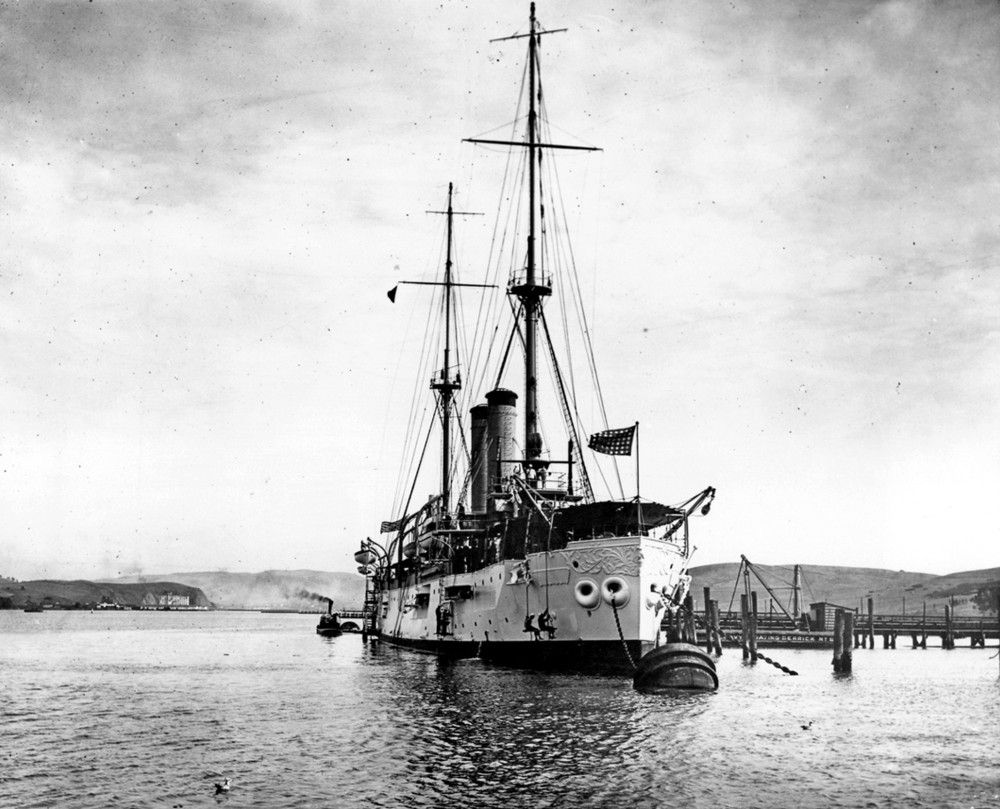
Figure 1: USS Cleveland (Cruiser No. 19) underway in 1904. US Naval Historical Center Photograph. Click on photograph for larger image.


Figure 2: USS Cleveland (Cruiser No. 19) photographed circa 1907, probably just before beginning her cruise to the Far East by way of the Suez Canal. Copied from the Album of Assistant Paymaster Francis J. Daly, by courtesy of Commander Thomas M. Daly, USN, 1984. US Naval Historical Center Photograph. US Naval Historical Center Photograph. Click on photograph for larger image.


Figure 3: USS Cleveland (Cruiser No. 19) in the "Dewey" Dry Dock, Olongapo Naval Station, Philippine Islands, circa 14 January 1908. Copied from the Album of Assistant Paymaster Francis J. Daly, by courtesy of Commander Thomas M. Daly, USN, 1984. US Naval Historical Center Photograph. Click on photograph for larger image.


Figure 4: USS Cleveland (Cruiser No. 19) in the "Dewey" Dry Dock, Olongapo Naval Station, Philippine Islands, circa 14 January 1908. Note her decorated stern and the officer posed on the starboard propeller. Copied from the Album of Assistant Paymaster Francis J. Daly, by courtesy of Commander Thomas M. Daly, USN, 1984. US Naval Historical Center Photograph. Click on photograph for larger image.


Figure 5: USS Cleveland (Cruiser No. 19) moored at Mare Island Navy Yard, California, in 1914 acting as the shipyard's receiving ship. US Navy photograph. Click on photograph for larger image.


Figure 6: Starboard side view of USS Cleveland (Cruiser No. 19) in the Mare Island Navy Yard channel on 25 April 1914. US Navy photograph. Click on photograph for larger image.


Figure 7: Port side view of USS Cleveland (Cruiser No. 19) in the Mare Island Navy Yard channel on 25 April 1914. US Navy photograph. Click on photograph for larger image.


Figure 8: USS Cleveland (Cruiser No. 19) off the Mare Island Navy Yard, California, 30 October 1915. Courtesy of Donald M. McPherson, 1970. US Naval Historical Center Photograph. Click on photograph for larger image.


Figure 9: Port side view of USS Cleveland (Cruiser No. 19) at Mare Island on 7 September 1916. The tug USS Active (YT-14) is behind Cleveland. US Navy Photograph. Click on photograph for larger image.


Figure 10: Starboard side view of USS Cleveland (Cruiser No. 19) at Mare Island on 7 September 1916. The tug USS Active (YT-14) is along side. US Navy Photograph. Click on photograph for larger image.


Figure 11: USS Cleveland (Cruiser No. 19) escorting a World War I convoy, 1918. The original image is printed on post card ("AZO") stock. Donation of Dr. Mark Kulikowski, 2007. US Naval Historical Center Photograph. Click on photograph for larger image.


Figure 12: USS Cleveland (CL-21), closest to the camera, and USS Galveston (CL-19) seen from USS Hannibal (AG-1), circa 1923, probably in Cuban waters. Courtesy of the Naval Historical Foundation. Collection of LeRoy R. Horstman. US Naval Historical Center Photograph. Click on photograph for larger image.


Figure 13: Painting of USS Cleveland (CL-21) by an unidentified artist. Courtesy of Mr. Fred Bristol, 1971. US Naval Historical Center Photograph. Click on photograph for larger image.


Figure 14: "In Remembrance of My Cruise in China, Japan and P.I." Silk embroidered tapestry featuring a photograph of Henry Rockwell Mousseau, his medals and an embroidered portrait of his ship, USS Cleveland (Cruiser No. 19). Cleveland served in the Far East during 1907-1910. Courtesy of Richard Mosseau, 1981. US Naval Historical Center Photograph. Click on photograph for larger image.


Named after a city in Ohio, the 3,200-ton USS Cleveland (Cruiser No. 19) was the last of six Denver class “protected cruisers,” which were ships that possessed armor protection on their main decks but not on their sides. Also known as “Peace Cruisers,” these slow, lightly-armed and armored ships were never meant for fleet actions. They were used as gunboats with the Asiatic Fleet and in the waters off Central America and South America, as well as in the Caribbean and the Mediterranean. Because they were needed to patrol distant waters with little support, the Denver class ships were furnished with sails to extend their cruising range while economizing on coal, but they also had large coal bunkers, which increased their range and endurance. Their steel hulls were sheathed with pine and coppered for long service in tropical waters and they possessed roomy, well-ventilated quarters for their crews to ease the discomfort of sailing in hot climates. Each Denver class warship had a two-and-one-half-inch-thick armored deck and was armed with ten 5-inch rapid-fire guns. USS Cleveland was built by the Bath Iron Works at Bath, Maine, and was commissioned 2 November 1903. She was approximately 308 feet long and 44 feet wide, had a top speed of 16 knots, and had a crew of 339 officers and men.

Cleveland was assigned first to the European Squadron and patrolled the waters off the West Indies, Cuba, and along the east coast of the United States. Cleveland remained with the European Squadron until 17 May 1907, when she left New York and headed to the Far East via Gibraltar, Port Said, Aden, Colombo, Singapore, and then finally arrived at Cavite in the Philippines on 1 August. Cleveland was part of the Asiatic Fleet for the next three years, protecting American lives and property in the area. Cleveland returned to the United States via the Pacific Ocean and arrived at the Mare Island Navy Yard, California, on 1 August 1910. She was decommissioned on 3 August and placed in reserve.

Cleveland was re-commissioned on 31 August 1912. The cruiser spent the next five years patrolling the waters off the coast of Mexico and Central America. As was usual for gunboats, Cleveland’s primary duty was to protect American lives and property in the politically volatile nations of Latin America. But with the United States drawing closer and closer to war with Germany, Cleveland was assigned to the east coast of the United States and on 31 March 1917 arrived at Hampton Roads, Virginia. From 9 April to 22 June, she patrolled from Cape Hatteras, North Carolina, to Charleston, South Carolina, searching for German submarines and surface raiders. From June 1917 to November 1918, Cleveland escorted seven convoys that were headed from the United States to Europe. She escorted the convoys to a midway point between the United States and Europe in the Atlantic Ocean. Cleveland then was relieved by Allied escorts from Britain or France that brought the convoy the rest of the way to Europe.

After the war ended in November 1918, Cleveland returned to patrolling off the coasts of Central and South America. But Cleveland once again was assigned to the Asiatic Fleet in February 1920. She also officially was re-classified as a gunboat (PG-33) in July 1920, but again was re-classified in August 1921, this time as a light cruiser (CL-21). Cleveland remained active in the Caribbean and South American waters during the 1920s, making courtesy calls to various ports, supporting diplomatic missions, providing disaster relief when necessary, and protecting American interests in the area when needed. USS Cleveland was decommissioned in Boston on 1 November 1929 and was sold for scrapping on 7 March 1930.