Tuesday, October 12, 2010

USS Randolph (CV-15, CVA-15, CVS-15)


Figure 1: USS Randolph (CV-15) in the Chesapeake Bay area during her shakedown period, 12 November 1944. She is wearing camouflage Measure 32 Design 17a. Photographed from USS Charger (CVE-30). Official US Navy Photograph, now in the collections of the National Archives. Click on photograph for larger image.


Figure 2: USS Randolph (CV-15) alongside a repair ship at Ulithi Atoll, Caroline Islands, 13 March 1945, showing damage to her after flight deck resulting from a "kamikaze" suicide plane hit on 11 March. Photographed from a USS Miami (CL-89) floatplane. Official US Navy Photograph, now in the collections of the National Archives. Click on photograph for larger image.


Figure 3: USS Randolph (CV-15) crewmen fighting fires on the ship's flight deck after she was hit by a "kamikaze" suicide plane, 11 March 1945. Official US Navy Photograph, now in the collections of the National Archives. Click on photograph for larger image.


Figure 4: Damage done to the flight deck of USS Randolph (CV-15) after hit by a “kamikaze” suicide plane on 11 March 1945. US Navy photograph. Click on photograph for larger image.


Figure 5: Another view of the damage done to the flight deck of USS Randolph (CV-15) after hit by a “kamikaze” suicide plane on 11 March 1945. US Navy photograph. Click on photograph for larger image.


Figure 6: USS Randolph (CV-15) at anchor in the western Pacific, June 1945. Photographed by Lieutenant Barrett Gallagher. Official US Navy Photograph, from the collections of the Naval Historical Center. Click on photograph for larger image.


Figure 7: Commander of Task Force 58 Vice Admiral Marc A. Mitscher, left, with his Chief of Staff, Commodore Arleigh A. Burke, on board USS Randolph (C V-15) during operations off Okinawa. Photograph is dated June 1945, but was probably taken in May. Official US Navy Photograph, now in the collections of the National Archives. Click on photograph for larger image.


Figure 8: Official US Navy photograph of USS Randolph (now CVA-15) after her SCB-27A modernization, with an interesting mix of F9F Cougars, AD Skyraiders and F4U Corsairs on deck. This photograph was probably taken during her post-modernization shakedown cruise to Guantánamo Bay, Cuba, August to November 1953, with Carrier Air Group 10 (CAG-10) aboard. Click on photograph for larger image.


Figure 9: Official US Navy photograph of USS Randolph (now CVA-15) after her SCB-27A modernization, with an interesting mix of F9F Cougars, AD Skyraiders and F4U Corsairs on deck. This photograph was probably taken during her post-modernization shakedown cruise to Guantánamo Bay, Cuba, August to November 1953, with Carrier Air Group 10 (CAG-10) aboard. Click on photograph for larger image.


Figure 10: USS Randolph (CVA-15) at Gibraltar, mid-February 1954. Randolph was relieving USS Bennington (CVA-20) after her Mediterranean cruise was completed. Photograph courtesy of Louis Hodgson. Click on photograph for larger image.


Figure 11: USS Randolph underway circa 1956-57. Photograph courtesy Don Smith (USN-RET). Click on photograph for larger image.


Figure 12: USS Randolph (CVA-15) stands at her assigned anchorage in Hampton Roads, Virginia, during the International Naval Review, 12 June 1957. Note her deck load of aircraft, with two AJ Savage attack planes and 14 FJ Fury fighters parked on the flight deck, forward. Photographed by PH2 Hughes. Official US Navy Photograph, from the collections of the Naval Historical Center. Click on photograph for larger image.


Figure 13: USS Randolph (now CVS-15) refueling at sea from USS Pawcatuck (AO-108), circa 1960. USS Waller (DDE-466) is refueling from the oiler's starboard side, while USS Eaton is steaming astern, waiting her turn for a "drink." Photograph received from USS Waller, 1969. US Naval Historical Center Photograph. Click on photograph for larger image.


Figure 14: Official US Navy photograph of USS Randolph (CVS-15) during an UNREP (UNderway REPlenishment) in the Atlantic, somewhere along the East coast, while conducting ASW (anti-submarine warfare) operations, September 1960. She is replenishing from USS Marias (AO-57) along with USS Cony (DDE-508). Click on photograph for larger image.


Figure 15: USS Randolph (CVS-15) underway at sea on 27 February 1962, with two S2F airplanes on her catapults. Official US Navy Photograph. Click on photograph for larger image.


Figure 16: Official US Navy photograph of USS Randolph (CVS-15) in September 1968. However, this photograph was possibly taken during the summer of 1967, since it shows Anti-Submarine Carrier Air Group 56 (tail code "AU") aboard Randolph. Click on photograph for larger image.


Figure 17: Sir Winston Churchill salutes as he receives honors during a visit to USS Randolph (CVA-15), 26 October 1958. Photographed by J.C. Ricks. Official US Navy Photograph, from the collections of the Naval Historical Center. Click on photograph for larger image.


Named after Peyton Randolph, the first president of the First Continental Congress, USS Randolph (CV-15) was a 36,380-ton, Ticonderoga class aircraft carrier that was built by the Newport News Shipbuilding & Dry Dock Company at Newport News, Virginia, and was commissioned on 9 October 1944. The ship was approximately 888 feet long and 93 feet wide, had a top speed of 32 knots, and had a crew of 3,448 officers and men. Randolph was heavily armed with 12 5-inch guns, 68 40-mm guns, and 59 20-mm guns. The carrier also carried roughly 80 aircraft, depending on the mission.

After a shakedown cruise in the Caribbean, Randolph went to the Pacific via the Panama Canal and on 31 December 1944 arrived at San Francisco, California. After taking on two air groups, Randolph left San Francisco on 20 January 1945 and steamed to Ulithi atoll in the Caroline Islands in the western Pacific Ocean. Once there, she joined Task Force 58 and on 16 February her aircraft began offensive bombing operations against the Japanese home islands. Randolph’s aircraft also supported American troops during the invasion of Iwo Jima, bombing enemy targets on land and shooting down Japanese suicide aircraft, or “kamikazes,” that were being launched against the American invasion fleet. On 25 February, after numerous bombing runs were made against Iwo Jima, Randolph returned to Ulithi for provisions.

But on 11 March 1945, while Randolph was at anchor at Ulithi, a Japanese suicide aircraft suddenly appeared over the island. It was a twin-engine bomber and it immediately dove towards Randolph. There was almost no time to react and the plane crashed through the starboard side of the rear flight deck and exploded inside the ship. The explosion and fire killed 25 men and wounded 106. But the crew scrambled into action and quickly put out the fire before it could do even more damage to the ship. The Navy decided to repair the carrier at Ulithi and, by 7 April, Randolph was able to join the invasion task force headed for Okinawa. Randolph’s planes not only hit targets on Okinawa, but they also provided critical combat air patrols that assisted in the protection of the invasion force against the dreaded Japanese kamikazes. Randolph itself was also under daily enemy air attacks from 17 April on, but the ship was not damaged. On 15 May, Randolph became flagship of Task Force 58 and continued supporting the occupation of Okinawa until 29 May, when she was sent to the Philippines.

Randolph then was attached to Admiral William “Bull” Halsey’s famous Third Fleet and her aircraft made a series of strikes against the Japanese home islands. On 10 July 1945, Randolph alone launched eight air strikes against airfields near Tokyo. On 14 July, her aircraft hit the airfields and shipping in and near Tsugaru Strait, in which two important Japanese train ferries were sunk and three were damaged. These aerial attacks against the Japanese home islands continued for several days until Randolph and several other carriers were moved to the southwest of the Japanese home islands. Once there, they began bombing targets on 24 July, hitting airfields and factories on Kyushu, Honshu, and Shikoku. Randolph’s pilots estimated that, from 10 to 25 July 1945, they destroyed 25 to 30 Japanese ships, ranging in size from small coastal transports to a 6,000-ton freighter, and had damaged 35 to 40 others. Randolph’s aircraft continued pounding Japanese ground targets right up until the morning of 15 August, when Japan surrendered.

After the war ended, Randolph was sent back to the United States in September 1945 and, after transiting the Panama Canal, joined the Atlantic Fleet. Over the next several months, Randolph was part of Operation “Magic Carpet” and made two round-trip crossings to the Mediterranean to bring home American servicemen. Randolph also made two trips to Europe while serving as a training ship in 1946 and 1947, but was decommissioned at the Philadelphia Naval Shipyard, Philadelphia, Pennsylvania, in February 1948.

Randolph was one of the carriers selected to undergo SCB-27A modernization and was re-commissioned in July 1953. The changes made to Randolph after the conversion were quite extensive. Her flight deck was reinforced to handle heavier and faster jet aircraft that were entering the Navy. More powerful catapults were installed, new arresting gear was added, and the gun armament was modernized. A distinctive feature was a new “island” structure on the starboard side of the flight deck that was taller in height and shorter in length than the previous structure. Other additions included increased storage for aviation gasoline, more powerful electrical generating capabilities, and better and safer weapons storage facilities. Randolph was now re-classified an attack aircraft carrier and given the new classification CVA-15.

Randolph was assigned to the US Sixth Fleet in the Mediterranean in 1954. From 1955 to 1956, Randolph was modernized once again and received an angled flight deck and an enclosed “hurricane” bow. She made three more deployments with the Sixth Fleet from 1956 to 1959, but was then converted to an anti-submarine support carrier in March of 1959 and was re-classified CVS-15. For the next ten years, Randolph participated in anti-submarine exercises in the Atlantic and Mediterranean, and off the coast of northern Europe. Randolph also acted as the support ship for the early Mercury manned space flights and then took a very active part in the naval “quarantine” of Cuba during the Cuban Missile Crisis. Since the Soviet Union sent submarines to Cuba and Randolph was an anti-submarine warfare carrier, there was a very real possibility that Randolph’s aircraft could have been on the front lines of a naval war between the United States and the Soviet Union. Luckily, it did not come to that.

USS Randolph continued her duties until she was decommissioned for the last time on 13 February 1969 at the Philadelphia Naval Shipyard. This proud ship was sold for scrapping in May of 1975. Randolph received three battle stars for her service during World War II.

Tuesday, October 5, 2010

USS Charleston (PG-51)


Figure 1: USS Charleston (PG-51) under construction at the Charleston Navy Yard, Charleston, South Carolina, circa February 1936. US Navy photograph. Click on photograph for larger image.


Figure 2: USS Charleston (PG-51) at the Panama Canal circa 1938. Photograph courtesy of Darryl Baker. Click on photograph for larger image.


Figure 3: USS Charleston (PG-51) circa March 1944, place unknown. US Navy photograph. Click on photograph for larger image.


Figure 4: USS Charleston (PG-51) circa March 1944, place unknown. US Navy photograph. Click on photograph for larger image.


Figure 5: Camouflage Measure 31, Design 3D. Drawing prepared by the Bureau of Ships for a camouflage scheme intended for gunboats of the Erie PG-50 class. This plan, approved by Captain Logan McKee, USN, is dated 25 February 1944. It shows the ship's port side and superstructure ends. USS Charleston (PG-51) wore this camouflage design. Official US Navy Photograph, now in the collections of the National Archives. Click on photograph for larger image.


Figure 6: Camouflage Measure 31, Design 3D. Drawing prepared by the Bureau of Ships for a camouflage scheme intended for gunboats of the Erie PG-50 class. This plan, approved by Captain Logan McKee, USN, is dated 25 February 1944. It shows the ship's starboard side. USS Charleston (PG-51) wore this camouflage design. Official US Navy Photograph, now in the collections of the National Archives. Click on photograph for larger image.


Figure 7: USS Charleston (PG-51) during World War II, date and place unknown. US Navy photograph. Click on photograph for larger image.


Figure 8: Stern view of USS Charleston (PG-51) during World War II, date and place unknown. US Navy photograph. Click on photograph for larger image.


Figure 9: United States Training Ship (USTS) Charleston as she appeared at Boston, Massachusetts, in 1951. Courtesy of the Massachusetts Maritime Academy. Click on photograph for larger image.


Figure 10: USTS Charleston at the Boston Shipyard, Boston, Massachusetts, in the fall of 1955. She is seen here in dry dock just before deploying for a three-month training cruise to the Mediterranean in January 1956. Courtesy of CDR Jack Dowd, USNR, Ret. Click on photograph for larger image.


Figure 11: Stern view of USTS Charleston at the Boston Shipyard, Boston, Massachusetts, in the fall of 1955. She is seen here in dry dock just before deploying for a three-month training cruise to the Mediterranean in January 1956. Courtesy of CDR Jack Dowd, USNR, Ret. Click on photograph for larger image.


Named after the city in South Carolina, USS Charleston (PG-51) was a 2,000-ton Erie class gunboat that was built by the Charleston Navy Yard at Charleston, South Carolina, and was commissioned on 8 July 1936. The Erie class was supposed to be a modern version of the old “Peace Cruisers” of the Denver class, which were used primarily as gunboats in the Caribbean, off South and Central America, and with the Asiatic Fleet. USS Charleston was approximately 328 feet long and 41 feet wide, had a top speed of 20 knots, and had a crew of 236 officers and men. The ship initially was armed with four 6-inch guns, but four 1.1-inch guns, six 20-mm cannons, and two depth-charge tracks were added once the United States entered World War II. Although Charleston was supposed to perform the same duties as a normal fleet cruiser, she was too slow, too small, and too lightly armored to perform that task. She, therefore, was primarily used as a standard gunboat to protect American lives and property in countries around the world.

After her shakedown cruise off the east coast of the United States, Charleston left Norfolk, Virginia, on 24 February 1937, sailed to the Mediterranean and joined Squadron 40T, a task force created to protect American lives and interests in that part of the world during the Spanish Civil War. While with that squadron, Charleston visited ports in Yugoslavia, Italy, and Algeria before returning to the United States on 24 April for an overhaul. On 9 July, the ship left Charleston and headed for Balboa in the Panama Canal Zone. Once there, Charleston became the flagship for the Special Service Squadron and participated in various naval exercises off Panama until 1 March 1938, when she returned to Charleston.

Charleston was assigned to the Caribbean from April to October 1938. From January 1939 to June 1940, the gunboat participated in Army-Navy exercises, conducted patrols off the east coast of the United States, and visited ports in Central America and Mexico. Then on 8 September 1940, Charleston left Norfolk and was sent to Seattle, Washington, where she began her new job as flagship for the Commander of the Alaskan Sector, Thirteenth Naval District. From November 1940 to November 1941, Charleston made five cruises from Seattle to Alaska and the Aleutian Islands.

After the United States entered World War II on 7 December 1941, Charleston was assigned to numerous patrol and convoy escort duties in the Alaska/Aleutian Islands area of operations. Aside from four trips Charleston made to west coast ports for overhauls, the ship was based at either Dutch Harbor or Kodiak in the Aleutians for the rest of the war. Although her primary jobs were patrol and convoy escort duties, Charleston also transported and landed military reconnaissance parties, assisted ships in distress, and participated in the assault on the island of Attu in the Aleutians, which took place on 11 May 1943. Two days later, Charleston’s guns supported US Army troops on Attu by bombarding enemy positions at Chichagof Harbor. The gunboat also screened and protected American transports that were anchored off the island. During a Japanese aerial attack on 22 May, Charleston avoided several torpedoes that were aimed at her and her guns shot down one of the attacking aircraft. Charleston provided gunfire support for Army troops until enemy resistance ended and she assisted in the occupation of the island by escorting convoys between Attu and Adak in the Aleutians. While assigned to the Aleutians campaign, Charleston completed 130 escort missions which included a total of 253 convoyed ships.

By the end of the war, Charleston was overhauled and prepared for duty in the Far East. On 25 November 1945, the ship arrived at Hong Kong. She also made a trip to Shanghai before returning to the United States on 4 March 1946. USS Charleston was decommissioned in San Francisco, California, on 10 May 1946 and transferred to the Massachusetts Maritime Academy on 25 March 1948. She was used as a training ship for the academy until 1959, when she was sold to an Italian investor who planned to convert the ship into a floating nightclub and hotel. The final fate of the ship is unknown.

USS Charleston represented the end of the famous “Gunboat Era,” when relatively large seagoing warships (not small, coastal craft) were built specifically to protect American lives and property during peacetime in distant lands around the world. They were never meant for major fleet actions and usually acted alone, whether off the shores of Mexico, South or Central America, and the Caribbean, or defending American interests in the Far East, especially in the Philippines and China. The Erie class was not that successful and only two ships in this class were built. But gunboats like USS Charleston provided invaluable service to the US Navy over several decades. After World War II, all of the gunboat’s duties were performed by larger fleet units, such as aircraft carriers, battleships, cruisers, destroyers, or even frigates. But the day of the “Peace Cruisers” and gunboats, ships that were specifically designed to defend American lives and property in far-off countries, was over.

Tuesday, September 28, 2010

USS Piscataqua


Figure 1: The tug W.H. Brown photographed in 1897 or 1898. This tug became USS Piscataqua in 1898 and was designated AT-49 in 1920. US Naval Historical Center Photograph. Click on photograph for larger image.


Figure 2: Fine screen halftone reproduction of a photograph taken in 1899 of USS Piscataqua. Copied from "The New Navy of the United States," by N.L. Stebbins (New York, 1912). Donation of David Shadell, 1987. US Naval Historical Center Photograph. Click on photograph for larger image.


Figure 3: USS Wompatuck, left, and USS Piscataqua, right, at Algiers, Algeria, circa January 1901, while en route from the US to the Philippines. The original print was a halftoned image. Courtesy of Donald M. McPherson, 1975. US Naval Historical Center Photograph. Click on photograph for larger image.


Figure 4: USS Piscataqua at Guam, circa 1910. The original image was printed on postal card ("AZO") stock. Donation of Dr. Mark Kulikowski, 2006. US Naval Historical Center Photograph. Click on photograph for larger image.


Figure 5: USS Piscataqua off Olongapo Naval Station, Philippine Islands, prior to 1920. Courtesy of Donald M. McPherson, 1978. US Naval Historical Center Photograph. Click on photograph for larger image.


Figure 6: View of the waterfront of the Olongapo Naval Station, Philippines, circa 1914-1916. Ships present are (from left to right): USS Monadnock (Monitor No. 3); USS Monterey (Monitor No. 6); USS Bainbridge (Destroyer No. 1); USS Decatur (Destroyer No. 5); USS Pampanga; and USS Piscataqua. Collection of C.A. Shively, 1978. US Naval Historical Center Photograph. Click on photograph for larger image.


Figure 7: Asiatic Fleet ships dressed with flags in honor of George Washington's birthday, 22 February 1915, probably in a Philippine Islands harbor. The three ships in the distance are (from left to right): USS Cincinnati (Cruiser No. 7); USS Piscataqua; and USS Dale (Destroyer No. 4). Collection of C.A. Shively. US Naval Historical Center Photograph. Click on photograph for larger image.


Named after a river located between the states of Maine and New Hampshire, USS Piscataqua was an 854-ton commercial tugboat that originally was called the W.H. Brown and was built in 1897 by the F.W. Wheeler Company at West Bay City, Michigan, for W.H. Brown & Company. Due to a need for more tugboats during the Spanish-American War, the US Navy purchased the ship on 11 May 1898 and renamed her USS Piscataqua. The tugboat was commissioned on 18 June 1898 and was approximately 149 feet long and 28 feet wide, had a top speed of 16 knots, and had a crew of 58 officers and men. Piscataqua was also armed with two 3-pounder cannons.

Piscataqua was immediately sent south and served off the coast of Cuba for the rest of the Spanish-American war. In 1900, she was assigned to the Asiatic Station and made her way eastward to Europe. After crossing the Atlantic, Piscataqua steamed along the Mediterranean, making numerous stops along the way. She then transited the Suez Canal and eventually made her way to the Philippines.

Piscataqua spent the rest of her career with the US Asiatic Fleet. She visited ports throughout the Philippines and even made a voyage to Guam. The ship was re-designated AT-49 in July 1920. USS Piscataqua was decommissioned in Cavite, the Philippines, on 10 April 1922 but was not sold for scrapping until 7 January 1931 in Manila.

Given their size and limited endurance, ships like Piscataqua traveled enormous distances during their careers. For a 149-foot tugboat in 1900 to make her way across the Atlantic, the Mediterranean, through the Suez Canal, and then to the Philippines is an accomplishment in and of itself. But then the ship went on to give another 20 years of solid service to the US Navy with the Asiatic Fleet, traveling throughout the Philippines and also to Guam. Some tugboats were even used as small gunboats in the Far East, especially in China, although Piscataqua seems to have avoided any armed confrontations. They were small ships that were required to perform big jobs, although few, if any, are remembered today.

Tuesday, September 21, 2010

USS Dale (DD-353)


Figure 1: USS Dale (DD-353) photographed by the New York Navy Yard, 22 July 1935. US Naval Historical Center Photograph. Click on photograph for larger image.


Figure 2: USS Dale (DD-353), left, leading USS Monaghan (DD-354) through a turn during an exhibition by Destroyer Squadron Twenty ships, staged for Movietone News, off San Diego, California, on 14 September 1936. Courtesy of Commander Robert L. Ghormley, Jr., USN, 1969. US Naval Historical Center Photograph. Click on photograph for larger image.


Figure 3: USS Dale (DD-353) underway circa 1935-1937. US Naval Historical Center Photograph. Click on photograph for larger image.


Figure 4: USS Dale (DD-353) steaming at sea, circa 1935-1937. US Naval Historical Center Photograph. Click on photograph for larger image.


Figure 5: USS Dale (DD-353) at sea on 10 March 1937. US Naval Historical Center Photograph. Click on photograph for larger image.


Figure 6: USS Dale (DD-353) operating at sea with the battle fleet, circa 1937-1940. US Naval Historical Center Photograph. Click on photograph for larger image.


Figure 7: USS Dale (DD-353) underway on 28 April 1938. Official US Navy Photograph, now in the collections of the National Archives. Click on photograph for larger image.


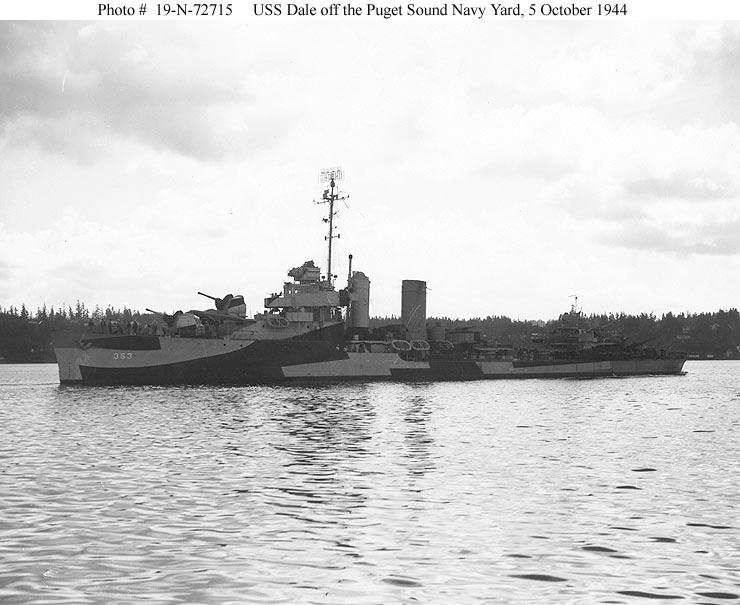
Figure 8: USS Dale (DD-353) off the Puget Sound Navy Yard, Washington, 5 October 1944. Her camouflage scheme is Measure 31, Design 6d. Photograph from the Bureau of Ships Collection in the US National Archives. Click on photograph for larger image.


Figure 9: USS Dale (DD-353) off the Puget Sound Navy Yard, Washington, 5 October 1944. The ship is painted in camouflage Measure 31, Design 6d. US Naval Historical Center Photograph. Click on photograph for larger image.


Figure 10: USS Dale (DD-353) off the Puget Sound Navy Yard, Washington, 5 October 1944. Her camouflage is Measure 31, Design 6d. Photograph from the Bureau of Ships Collection in the US National Archives. Click on photograph for larger image.


Figure 11: USS Dale (DD-353) underway at sea, June 1944, probably during the Marianas operation. Note ships conducting replenishment operations in the distance. Official US Navy Photograph, now in the collections of the National Archives. Click on photograph for larger image.


Named after Commodore Richard Dale (1756-1826), who served in the Continental Navy during the Revolutionary War and in the United States Navy in the late 1790s and early 1800s, USS Dale was a 1,395-ton Farragut class destroyer that was built at the Brooklyn Navy Yard, New York, and was commissioned on 17 June 1935. The ship was approximately 341 feet long and 34 feet wide, had a top speed of 36 knots, and had a crew of 160 officers and men. Dale was armed with five 5-inch guns, eight 21-inch torpedo tubes, and depth charges, but this armament was modified during World War II.

After being commissioned, Dale was sent to the Gulf of Mexico and the Bahamas, but was soon transferred to the Pacific. Throughout the rest of the 1930s, Dale participated in the usual peace-time naval exercises in the US Fleet and visited numerous ports, from Alaska to Peru. She also served as a gunnery training ship. In October 1939, Dale was sent to Hawaii and was stationed at Pearl Harbor. Dale was at Pearl Harbor during the Japanese attack on 7 December 1941, but the officer on duty at the time (an ensign) managed to get the ship underway and established a patrol off the entrance of the harbor. Dale’s guns opened fire on the oncoming Japanese aircraft and managed to shoot one of them down.

During the first months of the war, Dale was assigned to patrol and escort duties and screened aircraft carriers in some of the US Navy’s first counterattacks against Japan. From 14 December 1941 to 17 March 1942, Dale escorted the aircraft carriers USS Lexington (CV-2) and USS Yorktown (CV-5), which participated in air strikes against New Guinea on 10 March. Dale also screened USS Saratoga (CV-3) and escorted transports in early August 1942 during the invasion of Guadalcanal and Tulagi in the battle for the Solomon Islands. She continued escorting transports and merchant ships throughout the rest of the year.

On 9 January 1943, Dale left San Francisco, California, and was sent to the Aleutian Islands off Alaska. She participated in the occupation of Amchitka from 23 January to 19 March, patrolling the area and fighting off various Japanese attacks. On 22 March, the task force Dale was in steamed west of Attu to intercept and sink any Japanese ships trying to reinforce Japanese troops on the islands of Attu and Kiska. On 26 March, Dale’s task force collided with a Japanese task force that was escorting troop transports bound for Attu. What resulted was the little-known Battle of the Komandorski Islands, when Dale actually fired on all of the Japanese cruisers in the enemy task force while, at the same time, escorting the damaged American cruiser USS Salt Lake City (CA-25). Evidently, the Japanese lost their nerve and did not press their advantage against the smaller American task force. The Japanese withdrew and their reinforcements failed to reach Attu, leaving the Japanese troops there to their fate. Dale went on to escort transports and was used as a fire support ship during the actual invasion of Attu on 11 May 1943. She continued patrolling the waters around Attu until 1 August. She was part of the pre-invasion bombardment of Kiska on 2 August and escorted troop transports during the actual invasion of the island on 15 August.

Dale was sent back to the central Pacific in September 1943 and during the next two months escorted ships on a raid on Wake Island and escorted landing ships during the invasion of Makin Atoll in the Gilbert Islands. During the first seven months of 1944, Dale supported the invasion of the Marshall Islands by escorting carrier strike forces in the area and she bombarded Japanese positions on Saipan and Guam during June and July. After an overhaul at the Puget Sound Navy Yard, Washington, Dale escorted logistics ships that were attached to carrier operations against the Philippines and the Japanese home islands. During June and July 1945, Dale assisted in the invasion of Borneo and then returned to escort duties. She returned to the United States shortly after the war ended in the Pacific. USS Dale was decommissioned in New York on 16 October 1945 and was sold for scrapping on 20 December 1946.

USS Dale had a very active career, including her participation in a now forgotten part of World War II, the Aleutian Islands campaign. It was a violent little part of World War II, fought under horrific weather conditions, and was the only part of the war actually fought on North American soil. It deserves recognition.

Tuesday, September 14, 2010

USS Tarawa (CV-40, later CVA-40, CVS-40, and AVT-12)


Figure 1: USS Tarawa (CV-40) goes down the ways at the Norfolk Navy Yard, Portsmouth, Virginia, after she was christened by Mrs. Julian C. Smith on 12 May 1945. Copied from typescript "History of the Norfolk Navy Yard in World War II," page 169. The original volume is in the collections of the Navy Department Library. US Naval Historical Center Photograph. Click on photograph for larger image.


Figure 2: USS Tarawa (CV-40) circa 1946. US Navy photograph. Click on photograph for larger image.


Figure 3: USS Tarawa (CVA-40) underway in the Mediterranean Sea, north of the Straits of Messina, Sicily, on 18 December 1952. She has F2H "Banshee" jet fighters on her catapults. Official US Navy Photograph, from the collections of the Naval Historical Center. Click on photograph for larger image.


Figure 4: USS Tarawa (CVA-40) underway, probably in the Mediterranean Sea on 18 December 1952. Official US Navy Photograph, from the collections of the Naval Historical Center. Click on photograph for larger image.


Figure 5: A Grumman F8F "Bearcat" fighter landing on board USS Tarawa (CV-40) at sunset, 4 November 1948, during operations in the western Pacific area. Official US Navy Photograph, now in the collections of the National Archives. Click on photograph for larger image.


Figure 6: Vought F4U-5 "Corsair" fighters from USS Tarawa (CV-40) fly in formation over the Mediterranean, 15 December 1952. Official US Navy Photograph, now in the collections of the National Archives. Click on photograph for larger image.


Figure 7: USS Tarawa (CVA-40) approaches the Pedro Miguel Locks, while transiting the Panama Canal on 31 August 1954. The carrier was en route back to the Atlantic in the final stages of her September 1953 - September 1954 world cruise. Note Grumman F9F "Panther" fighter in the right foreground. Most of the other planes visible are swept-wing "Cougar" fighters. Official US Navy Photograph, from the collections of the Naval Historical Center. Click on photograph for larger image.


Figure 8: USS Tarawa (CV-40) circa 1953-1954, location unknown. US Navy photograph. Click on photograph for larger image.


Figure 9: USS Tarawa at Sydney, Australia, 1954. US Navy photograph. Click on photograph for larger image.


Figure 10: Two S2F Trackers of VS-32 "Norsemen" fly by an iceberg during USS Tarawa's August–September 1958 cruise to the South Atlantic. Allyn Howard comments: "I was an air crewman on board one of the S2F's [in this photo]. We were going out on a routine flight and we were directed to fly by the iceberg for pictures. [...] The iceberg was a beautiful blue green color [...]" Tarawa herself can barely be seen in the left background. Courtesy Allyn Howard, VS-32 & VS-22, 1957–1960. Click on photograph for larger image.


Named after an atoll in the Gilbert Islands that was the scene of one of the bloodiest battles of World War II, USS Tarawa was a 27,100-ton Ticonderoga class aircraft carrier that was built by the Norfolk Navy Yard at Portsmouth, Virginia, and was commissioned on 8 December 1945. The ship was approximately 888 feet long and 93 feet wide, had a top speed of 33 knots, and had a crew of 3,448 officers and men. Tarawa was armed with 12 5-inch guns, 32 40-mm guns, and 46 20-mm guns, and could carry approximately 82 aircraft.

After completing her shakedown cruise in early 1946, Tarawa was assigned to the US Pacific Fleet in July. From July 1946 to April 1947, Tarawa was sent to the central and western Pacific, making stops at Saipan, the Mariana Islands, and Japan. Tarawa also visited Tsingtao, China, and Guam before returning to the United States. While based at San Francisco, California, Tarawa patrolled off the west coast of the United States and completed numerous training exercises. On 28 September 1948, Tarawa left San Diego, California, on a cruise that would take her around most of the world. She headed west and made stops at China, Singapore, Ceylon, and the Persian Gulf, and then entered the Mediterranean via the Suez Canal. Tarawa made additional stops in Greece, Turkey, and Crete before leaving the Mediterranean and heading for the United States. She arrived at Norfolk, Virginia, in February 1949. Tarawa was placed out of commission in June 1949.

Tarawa was called back to active duty after the start of the Korean War and was re-commissioned on 3 February 1951. She was assigned to the Sixth Fleet in the Mediterranean and was re-designated CVA-40 on 1 October 1952. From September 1953 to September 1954, Tarawa steamed around the world, conducting patrols in the Mediterranean and Far East. In December 1954, Tarawa entered the Boston Naval Shipyard at Boston, Massachusetts, for an overhaul and to be converted into an antisubmarine aircraft carrier. On 10 January 1955, Tarawa was re-designated CVS-40 and her conversion was completed by the summer of that year.

For the next five years, Tarawa served as an antisubmarine warfare (ASW) platform carrying helicopters and propeller-driven ASW aircraft. Based primarily at Norfolk, Virginia, Tarawa patrolled along the east coast of the United States and in the Caribbean. Tarawa had the important task of conducting barrier patrols against the growing Soviet submarine and surface fleet and she also assisted in the training of new Navy pilots for the Atlantic Fleet. Ships like Tarawa provided a credible defense against Soviet warships at a time when the Cold War could have erupted into a shooting war at any given moment.

But newer and larger aircraft carriers were entering the fleet, so in May 1960 Tarawa was decommissioned for the last time. She was placed in the Atlantic Reserve Fleet at Philadelphia, Pennsylvania, and was re-classified an aircraft transport (AVT-12) in May 1961. But Tarawa never served as an aircraft transport and on 3 October 1968 she was sold for scrapping. Although too late to serve in World War II, Tarawa and ships like her were the backbone of the fleet during the Cold War and they provided an excellent defense against a growing naval threat emanating from the Soviet Union.