Tuesday, October 23, 2012

USS Dorothea L. Dix (AP-67)


Figure 1:  USS Dorothea L. Dix (AP-67) moored at Norfolk, Virginia, 8 October 1942. US Navy photograph from the book US Amphibious Ships and Craft, by Norman Friedman. Click on photograph for larger image. 


Figure 2:  USS Dorothea L. Dix (AP-67) probably at the US Army Port of Embarkation Piers, Newport News, Virginia, 27 May 1943. US Army photograph. Click on photograph for larger image.  


Figure 3:  North Africa invasion, November 1942. US Navy ships off the Phosphate Pier at Safi, Morocco, on 10 November 1942. Beach "Red" is in the left background. Beach "Blue" is in the left center, with the harbor in the center and the town of Safi at right. Ships present are (from left to right center): USS Dorothea L. Dix (AP-67), USS Calvert (AP-65), USS Harris (AP-8), USS Lyon (AP-71) and USS Housatonic (AO-35). Official US Navy Photograph, now in the collections of the National Archives. Click on photograph for larger image.


Figure 4:  USS Dorothea L. Dix (AP-67) underway on 10 July 1943, the first day of the invasion of Sicily. A paravane is visible near the waterline about a third back from the bow. Photographed from USS Ancon (AGC-4). Note: the date 10 July 1943 is from the original caption. Because a full set of landing craft is embarked, it is possible that the photograph was taken earlier. Official US Navy Photograph, now in the collections of the National Archives. Click on photograph for larger image.  


Figure 5:  USS Dorothea L. Dix (AP-67). Halftone reproduction of a photograph taken during World War II, showing the ship in port. Copied from the book, Troopships of World War II, by Roland W. Charles. US Naval Historical Center Photograph. Click on photograph for larger image.  
 

Figure 6:  USS Dorothea L. Dix (AP-67) photographed circa 1945. Courtesy of Donald M. McPherson, 1976. US Naval Historical Center Photograph. Click on photograph for larger image.    


Figure 7:  Ex-USS Dorothea L. Dix (AP-67) as American Export Line's cargo liner SS Exemplar underway in the harbor at New York City, date unknown.  Courtesy of Gerhard Mueller-Debus. Click on photograph for larger image.

 
The 11,625-ton merchant steamship transport SS Exemplar was originally built by the Bethlehem Steel Company at Quincy, Massachusetts, and delivered to the American Export Lines on 1 August 1940. She served as a merchant transport with the American Export Lines until purchased by the War Shipping Administration and leased to Great Britain on 19 April 1941. The ship was placed into service by the British Ministry of War and re-named Empire Widgeon, but the transport was returned to the American War Shipping Administration on 17 April 1942 and leased back to her original owners, the American Export Lines, on 9 May 1942. However, due to the urgent need for military transports, the ship was acquired by the War Department three months later on 14 August 1942 and then given to the US Navy on 13 September 1942. The ship was commissioned on 17 September 1942 as the USS Dorothea L. Dix (AP-67), named after the famous American humanitarian and superintendent of female nurses during the Civil War, and was converted into an armed transport. The ship was approximately 473 feet long and 66 feet wide, had a top speed of 17 knots, and had a crew of 422 officers and men. Dorothea L. Dix was armed with four single 3-inch guns and two double 40-mm gun mounts. She could also carry roughly 1,550 troops plus 1,400 tons of cargo.
Dorothea L. Dix made her first voyage on 23 October 1942. She joined Task Force 34 for the invasion of French Morocco in North Africa. The ship landed Army troops and supply scout boats at Safi, French Morocco, from 8 to 12 November. Dorothea L. Dix returned to the United States and arrived at Norfolk, Virginia, on 24 November. From 12 December to 5 April 1943, the transport made two more trans-Atlantic voyages to Oran, Algeria, carrying US Army troops and nurses.
After completing amphibious exercises back at Norfolk, Dorothea L. Dix left on 8 June 1943 for Oran, arriving there on 22 June. On 5 July, the ship got underway for the invasion of Sicily, arriving off the coast of Scoglitti, Sicily, late on 9 July and unloading her troops and cargo early the next day under heavy air attacks. The transport embarked wounded and returned to Oran on 15 July. One week later, the ship was en route to New York, arriving there on 3 August. Another trip was made to Oran from 21 August to 21 September, after which the ship sailed on 8 October to Great Britain.
Dorothea L. Dix arrived at Gourock Bay, Scotland, on 17 October 1943 and sailed ten days later for Algiers. When the transport arrived there, she off-loaded the troops she was carrying and exchanged them for 243 survivors of the destroyer USS Beatty (DD-640), which was sunk by German aircraft off the coast of Algeria on 6 November 1943. The ship then went on to Oran to embark Army troops. Dorothea L. Dix unloaded cargo back at Gourock Bay from 24 to 30 November and then returned to New York, arriving there on 11 December. From 29 December to 10 March 1944, the transport carried troops on two voyages through U-boat infested waters from New York to Gourock Bay and Liverpool, England.   
On 23 March 1944, Dorothea L. Dix sailed from New York to Belfast, Northern Ireland, arriving there on 3 April. After some amphibious training, the ship was assigned to Temporary Transport Division 97 at Portland, England, on 5 June for the invasion of Normandy, France. The following day, 6 June 1944, Dorothea L. Dix participated in the bloody assault on the infamous “Omaha” Beach at Normandy.  After she unloaded all of her assault troops, Dorothea L. Dix carried wounded soldiers from the beachhead back to England the next day. Once she returned to England, the ship embarked troops and tanks and was sent to Naples, Italy, arriving there on 16 July.
Dorothea L. Dix left Naples on 13 August 1944 for the invasion of southern France two days later. After unloading tanks and troops during the landings, the ship continued to support this amphibious operation by shuttling French, British, Italian, as well as American troops from Italy to France over the next few months. Dorothea L. Dix eventually returned to New York on 8 November.
Dorothea L. Dix left New York on 18 December 1944 and, after transiting the Panama Canal, sailed on to San Francisco, California, arriving there on 4 January 1945. Two weeks later, the ship transported Army troops to Pearl Harbor, Hawaii, and returned to San Francisco on 2 February. After carrying more Army troops in the middle of winter to Attu in the Aleutian Islands off the coast of Alaska, Dorothea L. Dix left for Okinawa, reaching that destination on 1 May. After landing her troops on Okinawa, the ship embarked casualties and naval passengers and returned to San Francisco, arriving on 27 May.
From 10 June 1945 to 9 February 1946, Dorothea L. Dix served as a transport from San Francisco and other west coast ports to the Philippines, carrying Army replacements to the Pacific region and bringing back home veterans from the war. The ship returned to New York City on 29 March 1946 and was decommissioned there on 24 April 1946. Dorothea L. Dix was turned over to the Maritime Commission that same day. The ship was soon given back to her original owners, the American Export Lines, and was again re-named SS Exemplar. The veteran transport that participated in so many famous amphibious landings during her career was eventually sold for scrapping in December 1968.
Transports like Dorothea L. Dix received very little recognition during World War II, but the Allies could not have achieved final victory without them. They sailed through dangerous waters filled with German submarines, often in terrible weather, and they unloaded their precious cargo off hostile shores where enemy aircraft and artillery tried their best to sink them. Dorothea L. Dix received five battle stars for her service during World War II, an impressive number for a naval transport.

Tuesday, October 16, 2012

USS Vincennes (CA-44)


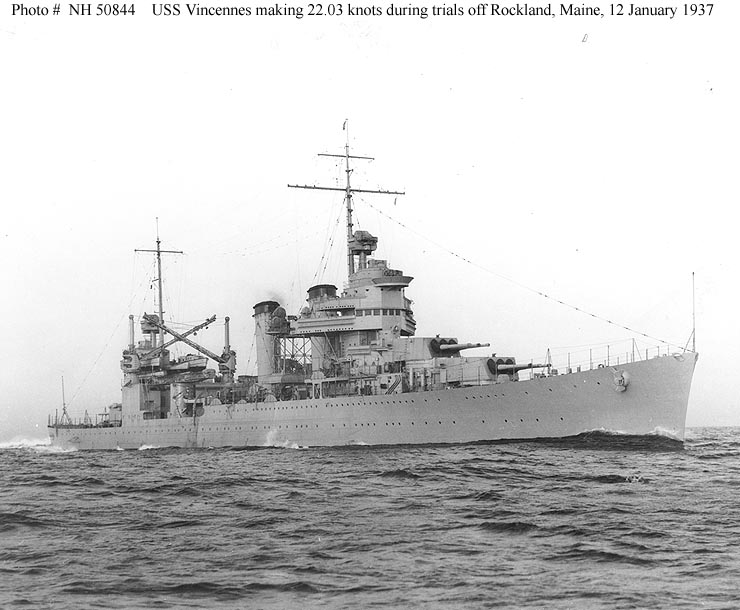
Figure 1:  USS Vincennes (CA-44) underway at 22.03 knots while on trials off Rockland, Maine, 12 January 1937. The photograph was taken while the ship was running south at 3:47 PM. US Naval Historical Center Photograph. Click on photograph for larger image.


Figure 2:  USS Vincennes (CA-44) making 10.74 knots during trials off Rockland, Maine, 12 January 1937. Photographed while the ship was running south, at 12:58 PM. Photograph from the Bureau of Ships Collection in the US National Archives. Click on photograph for larger image.   
 

Figure 3:  USS Vincennes (CA-44) steaming at high speed, circa February 1937. Courtesy of the US Naval Institute, Annapolis, Maryland, 1984. US Naval Historical Center Photograph. Click on photograph for larger image.


Figure 4:  USS Vincennes (CA-44) passing through the Panama Canal on 6 January 1938, while en route to join the US Fleet in the Pacific. Note crewmen on her deck, watching the airplane from which the photograph was taken. US Naval Historical Center Photograph. Click on photograph for larger image.


Figure 5:  Convoy to Iceland, September 1941. A signalman aboard USS Tuscaloosa (CA-37) uses a "long-glass" telescope to read communications from another ship, as Task Force 15 was en route to Iceland. Note signal lamp mounted next to the telescope and electrical hookup at left. Ships in the distance include USS Vincennes (CA-44) in the center and USS Republic (AP-39) further to the left. US Naval Historical Center Photograph. Click on photograph for larger image.


Figure 6:  Convoy WS-12. Vought SB2U scout bomber from USS Ranger (CV-4) flies anti-submarine patrol over the convoy, while it was en route to Cape Town, South Africa, 27 November 1941. The convoy appears to be making a formation turn from column to line abreast. Two-stack transports in the first row are USS West Point (AP-23) (left); USS Mount Vernon (AP-22) and USS Wakefield (AP-21). Heavy cruisers, on the right side of the first row and middle of the second, are USS Vincennes (CA-44) and USS Quincy (CA-39). Single-stack transports in the second row are USS Leonard Wood (AP-25) and USS Joseph T. Dickman (AP-26). Official US Navy Photograph, now in the collections of the National Archives. Click on photograph for larger image.  


Figure 7:  Doolittle Raid on Japan, 18 April 1942. View looking aft and to port from the island of USS Hornet (CV-8), while en route to the mission's launching point. USS Vincennes (CA-44) is in the distance. Several of the mission's sixteen B-25B bombers are visible. In the foreground is tail No. 40-2261, which was mission plane No. 7, piloted by 2nd Lieutenant Ted W. Lawson. The next plane is tail No. 40-2242, mission plane No. 8, piloted by Captain Edward J. York. Both aircraft attacked targets in the Tokyo area. Lt. Lawson later wrote the book Thirty Seconds over Tokyo. US Naval Historical Center Photograph. Click on photograph for larger image.   


Figure 8:  USS Vincennes (CA-44) at Pearl Harbor, circa 26-28 May 1942, prior to departing to take part in the Battle of Midway. A Curtiss SOC floatplane is in the left foreground. Official US Navy Photograph, now in the collections of the National Archives. Click on photograph for larger image.   


Figure 9:  Battle of Midway, June 1942. USS Yorktown (CV-5), in the distant left center, being abandoned after suffering torpedo damage on 4 June 1942. A destroyer is standing by off the listing carrier's stern, and USS Vincennes (CA-44) is steaming by in the middle distance. Official US Navy Photograph, now in the collections of the National Archives. Click on photograph for larger image.   
 

Figure 10:  USS Vincennes (CA-44) underway during tactical exercises in Hawaiian waters, 8 July 1942. Official US Navy Photograph, now in the collections of the U.S. National Archives. Click on photograph for larger image.  


Figure 11:  Pharmacist's Mate Edward Bykowski, USN receives a visit from Lieutenant Joshua L. Goldberg, USNR, Jewish Chaplain for the Third Naval District, on 10 February 1943. Bykowski is telling Lt. Goldberg of his rescue after he had been blown overboard from USS Vincennes (CA-44) when she was sunk on 9 August 1942, during the Battle of Savo Island. Both of his legs were broken. Looking on is Lieutenant Commander Ferold D. Lovejoy, USNR (Medical Corps). US Marine Corps Photograph. Click on photograph for larger image.


Figure 12:  USS Missouri (BB-63) Gunner's Mate Second Class Charles J. Hansen working on a 40-mm quad machine gun mount, during the battleship's shakedown period, circa August 1944. Note his tattoos, commemorating service on USS Vincennes (CA-44) and shipmates lost with her in the Battle of Savo Island on 9 August 1942. Official US Navy Photograph, now in the collections of the National Archives. Click on photograph for larger image.  

 
Named after a city in Indiana, the 9,400-ton USS Vincennes (CA-44) was a New Orleans class heavy cruiser that was built by the Bethlehem Shipbuilding Company at Quincy, Massachusetts, and was commissioned on 24 February 1937. The ship was approximately 588 feet long and 61 feet wide, had a top speed of 32 knots, and had a crew of 952 officers and men. Vincennes was armed with nine 8-inch guns, eight 5-inch guns, eight .50-caliber machine guns, and two 3-pounders, and also carried four seaplanes.   
In April of 1937, Vincennes went on her shakedown cruise to northern Europe. In early 1938, the heavy cruiser steamed through the Panama Canal and participated in naval exercises in the Pacific Ocean. Vincennes returned to the Atlantic in June 1939. After the outbreak of war in Europe in September 1939, Vincennes began patrols to enforce American neutrality and in June 1940 brought a shipment of gold from French Morocco to the United States. In 1941, Vincennes took part in combat readiness exercises in the Caribbean, including a large amphibious practice landing. The ship completed several more neutrality patrols and then was assigned to carry another gold shipment, only this time from South Africa to the United States. Vincennes was also given the task of escorting convoys in the north and south Atlantic.
After America entered the war on 7 December 1941, the United States became engaged in global combat operations. In March 1942, Vincennes transferred back to the Pacific. The next month, she escorted the aircraft carrier USS Hornet (CV-8) as she launched a deck load of Army B-25 bombers on the famous “Doolittle Raid” against targets on the Japanese home islands. After returning to Pearl Harbor, Hawaii, in late May, Vincennes was attached to the large carrier task force that participated in the epic Battle of Midway from 4 to 6 June 1942. During that momentous battle, Vincennes escorted the carrier USS Yorktown (CV-5). On 4 June, as Japanese aircraft attacked Yorktown, Vincennes put up an anti-aircraft screen of gunfire that did manage to shoot down one of the attacking planes. Unfortunately, some enemy aircraft made it through the curtain of lead that Vincennes was throwing up into the air and hit Yorktown. The carrier was mortally wounded and listing to port, eventually slowing to a halt, with smoke pouring out of the ship. Vincennes altered course around the carrier, screening the stricken warship from further air attacks. But on 6 June, Japanese submarine I-168 slipped by the American escorts in the task force and torpedoed Yorktown and the destroyer USS Hammann (DD-412), sinking the destroyer. Yorktown held on for a little longer, eventually sinking early on 7 June.
After the Battle of Midway, Vincennes returned to Pearl Harbor and entered the navy yard for repairs and alterations which lasted until early July 1942. After completing some tactical exercises off the coast of Hawaii, Vincennes was sent to the south Pacific in mid-July to participate in the invasion of Guadalcanal and Tulagi in the southern Solomon Islands. Vincennes was present during the amphibious landings on 7 and 8 August 1942, bombarding targets on land in support of US Marines and providing anti-aircraft protection for transports steaming off shore.
During the early hours after midnight on 9 August 1942, Vincennes was patrolling westward from Tulagi with her sister ships USS Astoria (CA-34) and USS Quincy (CA-39) when a large force of six Japanese cruisers and one destroyer attacked the three American cruisers. A searchlight illuminated Vincennes at approximately 0155 hours, and the American cruiser opened fire with her main battery to hit the ship the searchlight was on. Vincennes managed to hit one of the Japanese cruisers, but in firing her guns the American cruiser made herself a well-lit target for the other Japanese warships. Soon Vincennes was being pounded by numerous enemy shells. Vincennes was hit so many times that her internal communications were silenced and large fires engulfed portions of the ship. Vincennes was being methodically blown to pieces by the Japanese, who possessed a vast amount of experience and training in operating their warships at night. Some of the Japanese shells blew up the seaplanes in Vincennes’ hangar space and the crew was unable to control all the aviation gasoline that was burning as a result of these explosions. Most of the ship’s guns were by now inoperable and at 0200 hours Vincennes heeled to starboard in an attempt to evade the accurate enemy fire. Suddenly, two or three “long lance” torpedoes fired from one of the Japanese cruisers slammed into Vincennes’ Number 4 fireroom on the port side and put it out of action.
Losing steering control five minutes later, Vincennes was dead in the water within minutes. Enemy shells continued slamming into the ship while Vincennes was unable to respond because by now every gun was out of action. Vincennes was hit by at least 57 8-inch and 5-inch shells as the ship assumed an alarming list. Suddenly, at 0210 hours, the Japanese warships ceased fire and left the area, leaving all three American cruisers burning and sinking. At 0230, the order was given on board Vincennes to abandon ship. Life jackets and rafts were distributed to the survivors and the crew began the gut-wrenching task of leaving their stricken warship. At 0240, the ship’s commanding officer, Captain Frederick L. Riefkohl, went down to the main deck and joined the last men to leave the sinking cruiser, jumping into the warm water with what was left of his crew. At approximately 0250, USS Vincennes rolled over and sank roughly two and a half miles east of Savo Island. Of a crew of 952 officers and men, 332 were killed and 258 were wounded. Given the severe pounding sustained by Vincennes before she sank, it’s a wonder more men were not lost. The Battle of Savo Island was a complete disaster for the Allies. On that terrible night, three American and one Australian cruiser were sunk by the Japanese Navy. And this was just the opening round in what eventually would be known as the Naval Battle for Guadalcanal. In many ways, the worst was yet to come.

Tuesday, October 9, 2012

USS Turner (DD-648)


Figure 1:  The Gleaves class destroyer USS Turner (DD-648) headed for the Brooklyn Navy Yard at Brooklyn, New York, for a scheduled refit and repair period in April 1943. Photograph courtesy of Bill Gonyo. Click on photograph for larger image.


Figure 2:  USS Turner (DD-648) photographed from a blimp, 6 September 1943. Photograph courtesy of Fred Weiss; original print from the US National Archives.  Click on photograph for larger image.


Figure 3:  Photograph of USS Turner (DD-648) dated 18 January 1943, but actually taken several months later. This image was retouched by the wartime censor to remove radar antennas atop the ship's foremast and Mk. 37 gun director. However, the censor did not remove the SG radar antenna on the foremast.  Courtesy  Ed Zajkowski and Robert Hurst.  Click on photograph for larger image.     
 

Figure 4:  Captain Frank A. Erickson, United States Coast Guard (USCG). As the Coast Guard’s first helicopter pilot, Erickson flew badly needed blood plasma from New York City to Sandy Hook, New Jersey, in a terrible snowstorm to assist the wounded survivors from USS Turner, which sank off the coast of New York on 3 January 1944. It was the first time in history a helicopter was used in a life-saving emergency. Photograph courtesy of the USCG. Click on photograph for larger image.


Figure 5: Then-Commander Frank Erickson, Coast Guard Helicopter Pilot No. 1, in the cockpit of a Sikorsky HNS-1 Hoverfly. Photograph courtesy of the United States Coast Guard. Click on photograph for larger image.


Figure 6:  Commander Frank Erickson poses with a Sikorsky HNS-1 Hoverfly. Photograph courtesy of the United States Coast Guard. Click on photograph for larger image.     

Named after Captain Daniel Turner (1794-1850), a naval hero from the War of 1812, the 1,630-ton USS Turner (DD-648) was a Gleaves class destroyer that was built by the Federal Shipbuilding & Drydock Company at Kearney, New Jersey, and was commissioned on 15 April 1943. The ship was approximately 348 feet long and 36 feet wide, had a top speed of 37 knots, and had a crew of 261 officers and men. Turner was armed with four 5-inch guns, four 40-mm guns, five 20-mm guns, five 21-inch torpedo tubes, three “Mousetrap” depth-charge projectors, and two depth-charge tracks on the stern of the ship.
After completing her shakedown cruise in Casco Bay, Maine, in early June 1943, Turner steamed to New York City to prepare for her first assignment, a three-day training cruise with the newly commissioned aircraft carrier, USS Bunker Hill (CV-17). After that, the destroyer embarked on her first wartime assignment, which was to escort a convoy across the Atlantic Ocean. On 24 June 1943, Turner left Hampton Roads, Virginia, and assisted in escorting a convoy to Casablanca, French Morocco, arriving there on 18 July. Turner left Casablanca on 23 July to escort another convoy back to New York City, which arrived there on 9 August. Later that month, Turner was part of a convoy to Guantanamo Bay, Cuba, making a brief stop at Hampton Roads along the way. On the return trip back north, Turner rendezvoused with the aircraft carrier HMS Victorious and escorted the British ship to Norfolk, Virginia.
During the first two weeks of September 1943, Turner conducted anti-submarine warfare training at Casco Bay, Maine, and then returned to New York to prepare for her second trans-Atlantic voyage. On 21 September, the destroyer headed south to Norfolk. She arrived there on 23 September and the next day headed out across the Atlantic with a new convoy. After an eighteen-day journey, during which Turner made one depth-charge attack on a sound contact, the destroyer arrived at Casablanca on 12 October. Four days later, Turner left Casablanca and headed to Gibraltar to join another convoy. She reached Gibraltar on 17 October and after staying in port for two days joined convoy GUS-18 for the trip back to the United States.
On the night of 23 October 1943, while acting as an advance anti-submarine escort for the convoy she was sailing with, Turner located an unidentified surface contact on her radar. At approximately 1943 hours, only eleven minutes after making her initial radar contact, Turner’s lookouts made visual contact with what appeared to be a German U-boat running along the surface roughly 500 yards away. Turner immediately turned hard left and opened fire with her 5-inch, 40-mm, and 20-mm guns. Turner’s gunners scored one 5-inch hit on the U-boat’s conning tower, as well as several 40-mm and 20-mm hits on other parts of the enemy submarine. The U-boat began to dive and slipped beneath the surface before Turner had an opportunity to ram her. But as the U-boat dove deeper into the ocean, Turner began a depth-charge attack. Turner dropped two depth charges and both of them appeared to hit the water just above the submerged German submarine. As Turner kept moving over the area where the U-boat was, she dropped another depth charge off her stern. Soon after the three depth charges exploded, Turner’s crewmen heard a fourth explosion, the shock from which caused the destroyer to lose power to her radar systems, her main 5-inch battery, and her sonar equipment. It took Turner’s crewmen roughly 15 minutes to restore full power to the ship.
Once she re-gained full power, Turner began searching the area for evidence to corroborate a sinking or regain contact with the submarine. At 2017 hours, Turner picked up another contact on her radar, this one located roughly 1,500 yards off her port beam. Turner came left and headed toward the contact. Not long after that, crewmen on Turner’s bridge sighted an object lying low in the water. The crewmen on the bridge definitely identified the object as a submarine which appeared to be sinking by the stern. Unfortunately, Turner had to break contact with the U-boat in order to avoid a collision with another of the convoy’s escorts. By the time Turner was able to resume her search, the U-boat had disappeared. Turner and the destroyer escort USS Sturtevant (DE-239) remained in the area and conducted further searches for the submarine or for proof of her sinking but failed in both instances. All that can be said is that Turner probably heavily damaged the U-boat and may have sunk her, noting it only as a “probable kill.”
On 24 October, Turner and Sturtevant rejoined the convoy and all the ships continued their journey without further incident. The convoy then divided itself into two groups on 4 November. Turner took station as one of the escorts for the group that was headed for Norfolk. Two days later, Turner and the ships she was escorting safely reached port. Turner then left Norfolk to return to New York, where she arrived on 7 November.
After remaining ten days in port, Turner conducted anti-submarine warfare exercises at Casco Bay before returning to Norfolk to join another trans-Atlantic convoy. Turner left Norfolk with her third and final convoy on 23 November 1943 and brought the convoy safely across the Atlantic. On 1 January 1944, near the end of the return voyage to the United States, Turner’s convoy again split into two parts. Turner escorted the group of ships that was headed for New York City and continued in that direction. Turner arrived off Ambrose Light in lower New York Bay late on 2 January and anchored.
Early the next morning on 3 January 1944, for some unknown reason Turner suffered a series of enormous internal explosions. By 0650, the ship took on a 15-degree starboard list. Explosions (mostly in the ammunition stowage areas) continued to tear apart the battered destroyer. Then, at roughly 0750, a huge explosion caused the stricken warship to capsize and sink. The tip of her bow remained above water until 0827 and then she disappeared completely, taking with her 15 officers and 123 crewmen. After nearby ships picked up the survivors of the sunken destroyer, the injured crewmen were rushed to a hospital at Sandy Hook, New Jersey.  But the hospital at Sandy Hook needed vital blood plasma to treat many of Turner’s injured crewmen, plasma it needed quickly if those sailors were to survive.
Into this desperate situation stepped a remarkable man, Lieutenant Commander Frank A. Erickson, United States Coast Guard (USCG). Erickson had become the first Coast Guard helicopter pilot (Coast Guard Helicopter Pilot No. 1) in September 1943, flying the fragile Sikorsky HNS-1 Hoverfly helicopter. Erickson was a big believer in the future of helicopters, envisioning that one day they could be used for rescuing people on both land and sea. Erickson was also an instructor who trained 102 helicopter pilots and 225 mechanics, including personnel from the US Army Air Corps, Navy, and Coast Guard, as well as the British Army, Royal Air Force, and Royal Navy.
On 3 January 1944, Erickson received word that the hospital at Sandy Hook was in desperate need of blood plasma to save some of the surviving crewmen from the Turner disaster. Erickson answered the call for help by lashing two cases of blood plasma to the floats of his HNS-1 Hoverfly helicopter and flying from New York City to Sandy Hook during a violent snowstorm that grounded all the other aircraft in the area. Erickson successfully completed the mission and became the first helicopter pilot in the world to fly a helicopter under such conditions. It also was the first lifesaving flight ever performed by a helicopter. Many of those wounded sailors owed their lives to the plasma that was brought to them by a very brave pilot on board this new aircraft called a “helicopter.”
Erickson then developed the idea and the techniques for the practical use of a power hoist in helicopters. He demonstrated this near Jamaica Bay, New York, in 1944 as the pilot of the first helicopter to pick up a man from land on 11 August 1944; the first pick-up of a man floating in water on 14 August; and the first pick-up of a man from a life raft on 25 September. Those demonstrations led to an official commendation which he received in February 1945. His techniques in the use of the hydraulic hoist and related lifesaving equipment proved of invaluable assistance to military services and to non-military organizations. Erickson also proved that helicopters could be used for rescues involving the lifting of personnel, equipment, and cargo. His early demonstrations influenced the Army to use that equipment overseas and influenced the design of numerous helicopters in their developmental stages. He later also invented and patented a flight stabilizer for helicopters and developed inflatable pontoons for landing helicopters on water.
Erickson went on to have a stellar career testing and developing the use of helicopters with the Coast Guard and he pioneered the technique of landing helicopters on platforms that were built on board ships. He retired from the Coast Guard as a captain on 1 July 1954. He then went on to serve as the chief test pilot for the Brantly Helicopter Corporation while continuing to design a helicopter flight-path stabilizer. He assisted NASA’s Gemini program in developing a hoist system to lift an astronaut out of the water in emergency situations and consulted with the designers of the Coast Guard’s new 210-foot Reliance class cutters in designing those vessels’ helicopter landing pads. Captain Frank A. Erickson, a true pioneer in the history of aviation and a man possessed with limitless vision when it came to the potential of helicopters and their many uses, died on 17 December 1978 at the age of seventy-one.

Tuesday, October 2, 2012

USS Aztec (SP-590)


Figure 1:  American steam yacht Aztec, 1902. Photographed prior to World War I by Edwin Levick, New York. This yacht was acquired by the US Navy on 29 June 1917 and commissioned one day later as USS Aztec (SP-590). She was returned to her owner on 7 August 1919. The original print is in National Archives' Record Group 19-LCM. US Naval Historical Center Photograph. Click on photograph for larger image.


Figure 2:   USS Aztec (SP-590) at the Boston Navy Yard, Charlestown, Massachusetts, 20 December 1917. Note the ship's unique camouflage scheme and the coaling facility beyond her bow. US Naval Historical Center Photograph. Click on photograph for larger image.


Figure 3:  USS Aztec (SP-590) in port on 1 January 1918, probably at the Boston Navy Yard, Charlestown, Massachusetts. Note the ship's unique camouflage scheme and ice on the ship and the water. US Naval Historical Center Photograph. Click on photograph for larger image.


Figure 4:  The yacht Aztec in dry dock for inspection and repairs at Boston, Massachusetts, after being purchased by Mr. T.H.P. Molson of Canada. Courtesy of T.H.P Molson. Photograph from The Armed Yachts of Canada by Fraser McKee. Click on photograph for larger image.


Figure 5:  HMCS Beaver (S10), formerly USS Aztec (SP-590), also served in the Royal Canadian Navy (RCN). Initially carrying the pendant number S10 and later Z10, she was commissioned into the RCN on 4 April 1941. In this photograph, Beaver looks almost worn out from patrol duties. The ship was scrapped on 17 October 1944. Courtesy Department of National Defense [Canada], Historical Section. Photograph from The Armed Yachts of Canada by Fraser McKee. Click on photograph for larger image.

 
The 848-ton Aztec was originally built as a private steam yacht in 1902 by the Lewis Nixon Company at Elizabethport, New Jersey. Her owner, A.C. Burnage, leased her to the US Navy on 29 June 1917 for use during World War I. The ship was commissioned on 30 June and then converted into the gunboat USS Aztec (SP-590). She was approximately 260 feet long and 30 feet wide, had a top speed of 12 knots, and had a crew of 96 officers and men. Aztec was armed with two 3-inch guns and two machine guns.
Aztec’s conversion into a gunboat involved an extensive overhaul and repairs. After the conversion was completed, Aztec became the flagship for the First Naval District and was based at Boston, Massachusetts. As a flagship, Aztec made numerous inspection tours of naval bases within her district. She also escorted submarines steaming from Boston to New London, Connecticut, as well as British troop ships sailing from Boston to Halifax, Nova Scotia. While escorting one of these convoys to Nova Scotia, Aztec was asked to assist a foundering British transport. She lowered her boats and rescued several hundred troops from the sinking British ship.
During the last three months of World War I, Aztec patrolled the Grand Banks off Newfoundland. On 24 December 1918, the gunboat steamed to New York City and, on 26 December, with Assistant Secretary of the Navy Franklin D. Roosevelt on board, participated in a fleet review honoring the American battleships returning from duty in European waters.
Aztec continued serving in the First Naval District until she was placed out of commission on 15 March 1919. Aztec was returned to her owner on 7 August 1919 and converted back into a civilian yacht. But after the death of her owner in 1931, the former gunboat was laid up at Boston and remained there until purchased in early 1940 by Mr. T.H.P. Molson from Montreal, Canada, for service in the Royal Canadian Navy. Aztec was handed over to Canada on 28 May 1940 and was taken to Halifax, Nova Scotia, where she was converted back into a warship at the Halifax Shipyards Ltd. The ship was commissioned into the Royal Canadian Navy as HMCS Beaver (S10) in March 1941.
For the next year and a half, Beaver was assigned to antisubmarine patrols and was also used as a convoy escort. She was based at various times at Halifax and Sydney, Nova Scotia, and Saint John, New Brunswick. On 27 December 1942, Beaver was reassigned to duty as a tender to HMCS Cornwallis, which was based at Halifax. In early 1943, the ship was sent to a new base at Deep Brook, Nova Scotia.
From 9 February to 24 June 1944, Beaver completed a major overhaul at Halifax. At some point during this time, the Royal Canadian Navy decided to use the ship as a transport for naval personnel between Halifax and St. John’s, Newfoundland. Beaver served in this capacity through late September 1944, when serious mechanical and structural defects caused the gunboat to be placed in a dockyard at Halifax for repairs.
Because of the poor condition the ship was in, the Royal Canadian Navy decided that it wasn’t worth repairing the gunboat. Beaver was decommissioned on 17 October 1944 and eventually declared surplus on 13 July 1945. Beaver was eventually sold (probably for scrapping) on 7 January 1946.  So ended the amazing career of an American ship that was originally built as a civilian yacht, but went on to serve in two navies and in two different wars.